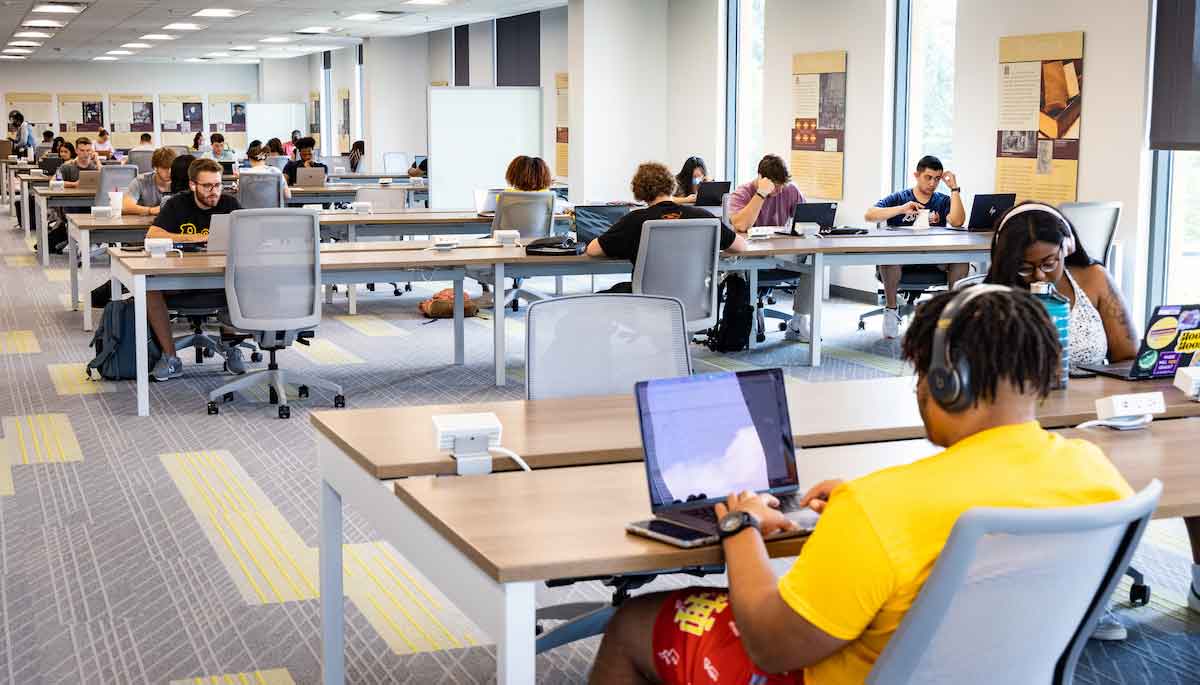
Students studying in the ALC study spaces. Photo Credit: Kennesaw State University
Kennesaw State Student Government Association (SGA) President Allisa George, a public health major, met with The Sentinel in February to discuss progress made toward her administration’s goals during a mid-semester meeting.
According to George, SGA has been working to create spaces for students to express their opinions on difficult campus conversations, such as housing and parking, and was able to establish 24/7 study spaces after advocating to the university about the importance of proper study areas.
The 24/7 study spaces, one of SGA’s most well-known initiatives, allow students to access designated areas on campus after hours to work on homework or study using their Talon Card.
“We recently, in collaboration with the university, emphasized and advocated that there is a need for 24/7 study space on campus… by the time that we got to finals, we were able to release our announcement about 24/7 study spaces. And that is an SGA initiative,” George said.
George felt that SGA was a cornerstone of civic engagement, and believed that the organization had a role to help create a respectful and productive bridge to communication for students, regardless of the issues at hand.
“I think with KSU, with SGA, we really prioritize civic engagement and civic conversations and making sure that everyone feels respected and heard in those specific spaces.”
Outside of current propositions, Student Government has been working to bridge students with the committees that serve them. George sees SGA as a space for difficult campus conversations and improving the political climate between students.
George emphasized the importance of impartiality, saying SGA must remain neutral in order to effectively handle issues on campus. However, she said neutrality does not mean ignoring issues that have left students divided, such as housing, parking or campus political culture.
“As SGA as a whole, we have to remain impartial,” George said, “That doesn’t mean that we cannot amplify students who are feeling this specific divide.”
A broader challenge through working towards making those conversations is the lack of conversations themselves. According to George, a huge issue that continues to be a backlog to proper solutions is the shift from actual dialogue.
“I think a lot of times, like, especially in our current society, the art of having a conversation is kind of lost,” George said. “We are making sure that we uphold our civic duty, as SGA members, to allow students to be able to have those hard conversations, but making sure that we’re representing all students in that specific aspect.”
To students who were looking to speak to SGA or get involved in seeing what SGA is working on, George encouraged the student body who actively feel unheard or have concerns to reach out to SGA via Instagram, or to visit their office in the Student Center on the 2nd Floor.
“Using the SGA suggestion box, like DMing us on Instagram and stuff like that, or even like showing up to the office and kind of expressing these… would really help and to allow us to amplify specific student voices and making sure people feel heard, especially with some students experiencing the divisive culture and things like that.”