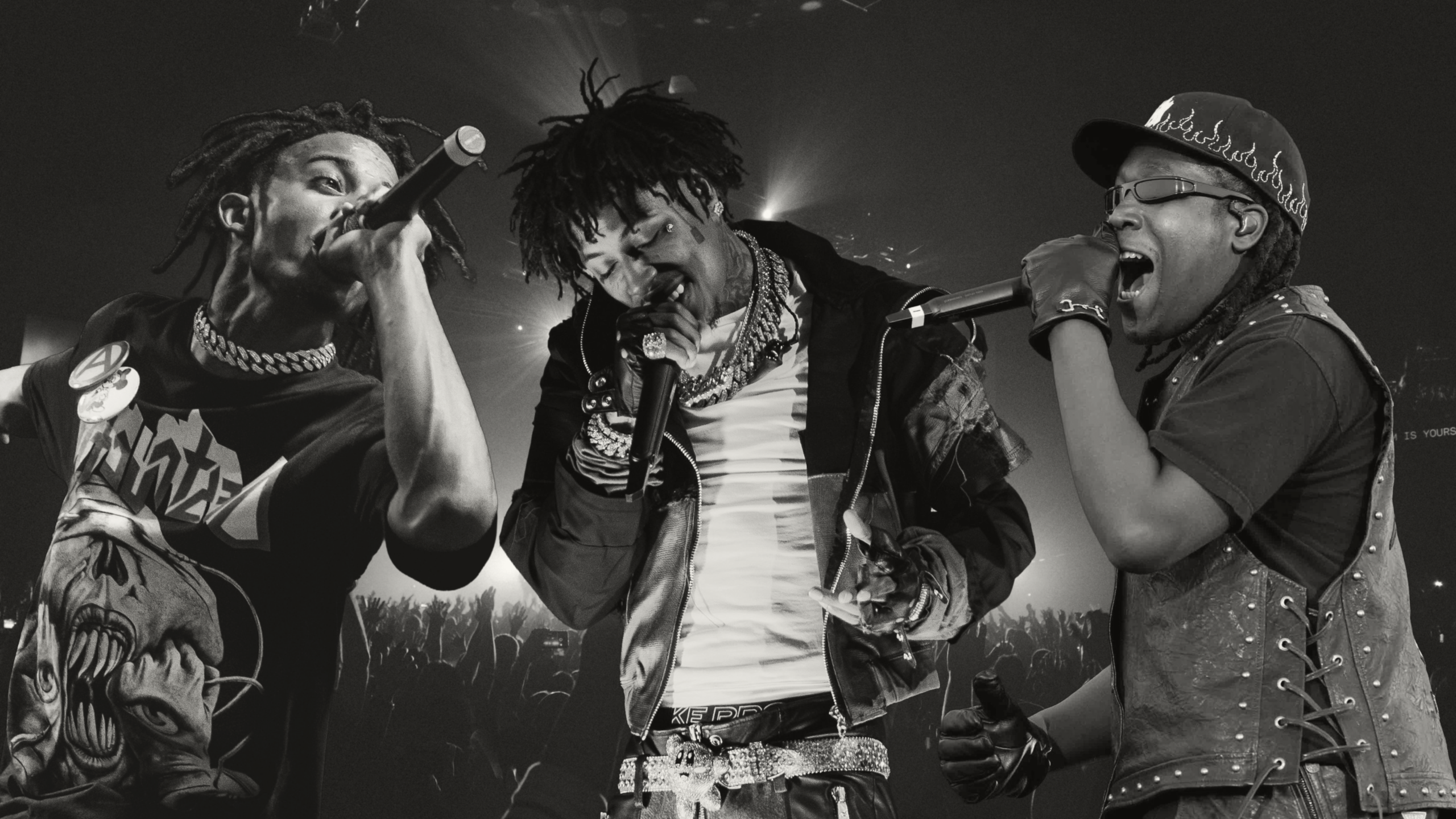
Photo Credit: Graphic by Tye Brown, The Sentinel. Headliners Playboy Carti, NBA YoungBoy and Don Toliver, who are set to perform at the 2026 Rolling Loud music festival.
The Rolling Loud 2026 lineup has divided fans and students alike, raising questions about whether hip-hop is losing its cultural dominance or simply evolving in how it reaches audiences.
Rolling Loud is considered one of the most influential hip-hop festivals in the world. It is often a direct reflection of where the genre stands at a given moment.
When the Rolling Loud 2026 list was announced, it was immediately met with mixed reactions. Some praised the festival for showcasing artists that are most popular right now, while others were led to question the current state of rap and hip-hop as a genre.
These reactions have sparked a broader conversation: as hip-hop continues to dominate streaming platforms, is rap losing its mainstream presence, or is it simply evolving in how it reaches audiences?
The festival — which will take place in May — includes artist headliners like Playboi Carti, NBA YoungBoy and Don Toliver. To some, these particular artists are all in similar subgenres of rap. Rolling Loud’s other performers, however, all stem from an underground niche of rap.
For many students, the mixed reaction to Rolling Loud’s lineup is not about disliking the artists; it’s about the missing presence of rap in the mainstream. A number of students pointed out that rap used to have artists that were often considered “bigger than rap.”
Artists like Drake, J. Cole and Kendrick Lamar weren’t just popular in rap— they were cultural staples. Even people who do not listen to rap recognized their names and influence on the music industry.
“Nowadays the average person doesn’t know any of the top rappers,” KSU student Jonathan Dupree said.
While many top artists like NBA Youngboy and Playboi Carti are still pulling in thousands of streams and selling out shows, they are still missing the universal recognition that rap artists once had.
One common critique amongst students is that the Rolling Loud lineup only represents one small slice of rap and not the genre as a whole.
“It just covers one niche of rap and doesn’t feed the masses,” Dupree said, pointing out how many of the artist fall under similar umbrellas.
Historically, Rolling loud has featured names like Action Bronson, Nicki Minaj, Kid Cudi and Future. These names highlight a time when hip-hop festivals were headlined by artists that could cater to a wider audience.
How music is consumed is a major factor in the decline of the genre. In the past, top artists benefited from being on the radio, making their music nearly unavoidable. The most popular rap songs could be heard in malls, cars, sports broadcasts and many other public spaces.
Today, that shared listening experience has largely disappeared as streaming platforms and social media become the main source for music. Normally apps like Spotify will recommend music that they think the user will enjoy, but it doesn’t reach out of that box much.
For the first time in 35 years, there was not a rap song included on the Billboard Hot 100 top 40. Kendrick Lamar’s “Luther” was removed in Oct. 2025. Without rap being pushed to a public audience, an artist’s opportunity to become popular is fleeting.
As rap leaves the radio, rap artists often become extremely popular to niche communities, but are largely unfamiliar to the general public.
As a result, rap’s cultural dominance feels less centralized than it once did. The genre hasn’t completely disappeared, but it has migrated away from mass platforms to small digital spaces.
Whether this shift represents the rap genre’s decline or evolution remains open to interpretation, but it highlights how success in rap is being redefined in an era where shared cultural moments are increasingly rare.