
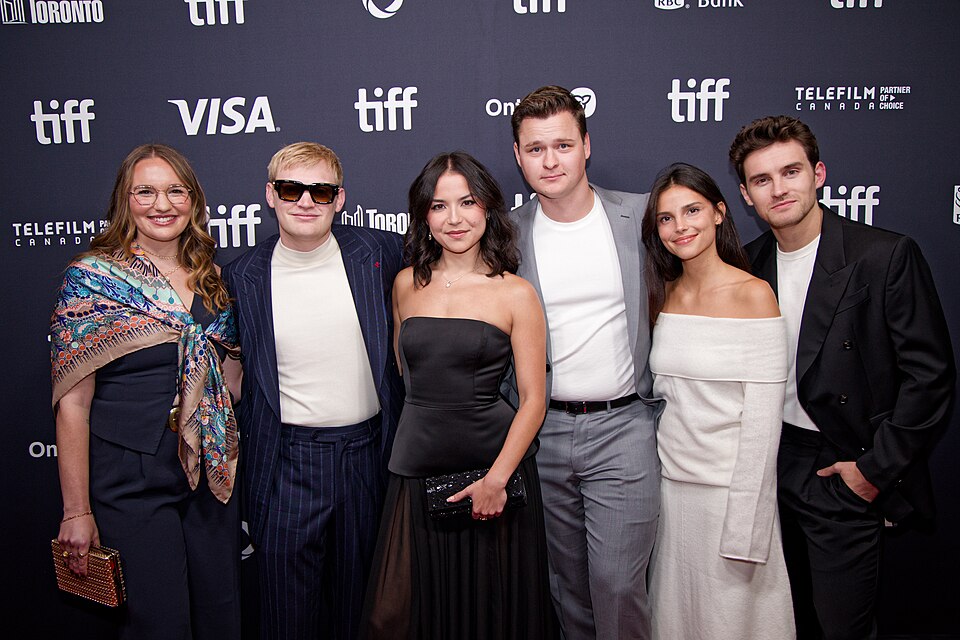
Cast and crew at the 2025 Toronto International Film Festival on Sep. 5, 2025 for Obsession, the highest grossing horror movie of 2026. Photo credit: Kevin Payravi/Wikimedia Commons.
2026 has become a record-breaking year for the horror genre with a domestic revenue of $1.16 billion. So far, the most successful original movies of the year have been horror movies.
According to Parrot Analytics, 76% of the highest grossing films in the past decade have been remakes, reboots or sequels. Roughly 63% to 70% of the top 20 movies of 2026 come from already established IPs, such as Spider-Man: Brand New Day and Toy Story 5. But trends are showing that customers are less likely to spend their money on original movies for fear of wasting it.
While the horror genre is not fully exempt from sequel-bait, unlike bigger companies such as Disney, horror reboots are usually developed by new directors that offer a new twist or creative direction. Lee Cronin’s The Mummy found success as a reimagining of Universal Pictures’ The Mummy franchise.
For the past decade, horror movies have become both an adrenaline fix for the audience and an opportunity for audiences to engage with original ideas.
Studios tend to be more willing to take chances on horror movies because they are lower budget productions, which allows more creative liberties. Lower budget also encourages horror directors to become more creative when cutting corners.
This is the main reason why Obsession is the highest grossing horror movie of 2026, with over $522 million despite its small budget of $750,000. Its use of practical effects, unknown actors and grounded setting helped audiences easily engage with the film.
Due to budget constraints, indie horror films often utilize practical effects.
The production crew of Backrooms created a 30,000-square-feet physical set to replicate the maze-like structure. The main monster of this film was also played by a seven-foot-tall basketball player named Robert Bobroczkyi instead of using computer-generated imagery. Watching the actors in the movie physically interact with the setting helps the audience feel engaged with the movie, like they are actually in the Backrooms.
Many mainstream films use computer-generated imagery in some capacity. In recent years, audiences have expressed disdain for the abundance of non-practical effects.
For example, films like Moana (2026) can become distracting to the audience. With every shot, they are reminded that the actors are acting in front of a green screen with inanimate objects.
Along with desensitization to digital effects, audiences can also have trouble engaging with modern films due to overexposure to seeing the same actors in movies every year.
Movies like Christopher Nolan’s The Odyssey are filled with A-list actors as a marketing strategy rather than casting the roles based on how well the actors match their character.
Obsession worked so well because the director casted newer and unknown actors to play all the characters. Removing the celebrity barrier added to the horror that this situation can happen to anyone.
Despite its overwhelming success, Obsession only reached its peak during the movie’s third weekend in theaters, earning $26.4 million domestically. The buzz surrounding the movie is what drove audiences to see it in theaters rather than wait for it to go to streaming.
Due to a lack of theater attendance in recent years, word of the mouth has become a more popular way to promote a film rather than watching trailers. The horror genre’s vocal fanbase has helped many 2026 horror releases.
The movie Buddy only released a handful of teaser trailers two months before the film’s release in August. However, the film has grossed over $26 million at the box office. The film received a 6% increase during its second weekend through online film reviewers and horror fandom.
Modern movie audiences seem more likely to trust their favorite movie reviewer’s opinion rather than the film’s Rotten Tomatoes score.
The success from 2026 horror movies is proof that Hollywood doesn’t need to spend millions of dollars on A-list films. There is a reward in learning from horror directors.
Worldwide audiences have gone as far as to say that 2026 is “one of the strongest years for horror in a long time.”
There are only two months left in the year, and with anticipated titles such as Clayface, The Werewulf and Victorian Psycho, the horror genre is sure to live up to this statement.