
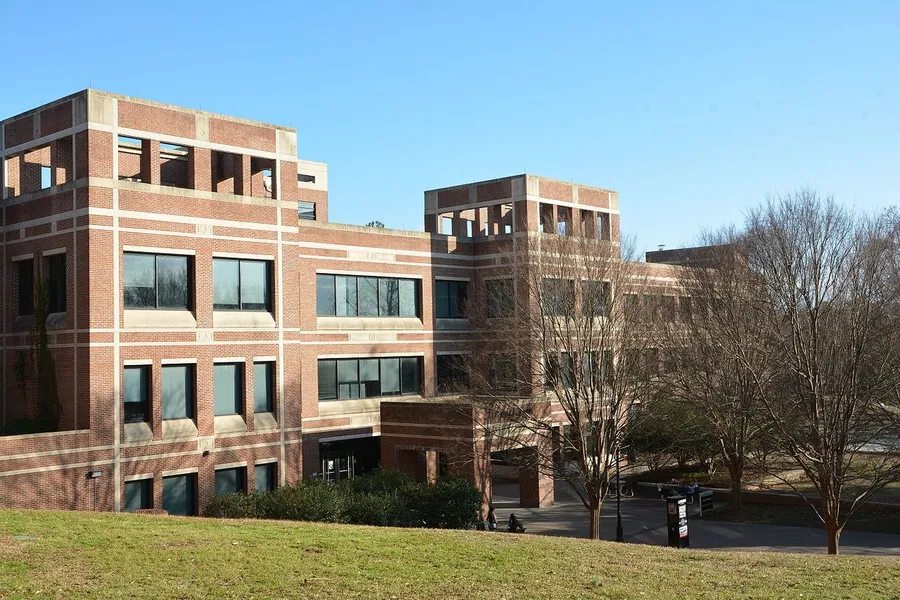
The KSU Atrium Building, where the College of Computing and Software Engineering and KSU AI clubs are held. [Photo via Wikimedia Commons / CC BY-SA 4.0.]
The capabilities and power of artificial intelligence (AI) are rapidly expanding, positioning AI as one of the most significant developments in modern technology.
Students at Kennesaw State University refuse to sit on the sidelines during this pivotal moment in technological history. From healthcare advancements to aerospace engineering, these young adults are molding the future of AI and its impact on humanity in real time.
Vijay Wulfekuhle

Master’s student Vijay Wulfekuhle stands outside KSU’s Engineering Technology Center on the Marietta campus. Photo by Devyn Byers.
KSU student Vijay Wulfekuhle earned his bachelor’s degree in computer science, and he is now pursuing a Master of Science in Robotics. He believes that artificial intelligence can largely benefit society when used correctly, and his work reflects this positive outlook on the technological “tool.”
“The use of tools is kind of what defines us,” Wulfekuhle said. “With every new tool, there comes a decision on how to use it ethically and for humanity’s benefit … ideally, these new technologies [will] allow people to do better and bigger things.”
Wulfekuhle has been involved with multiple AI projects — like “robot manipulators” and “autonomous ground vehicles” — but his current research is on AI-enhanced wearable prosthetics.
The goal of this project is to develop affordable, high-performance prosthetic devices with integrated AI-driven control systems that both learn from and adapt to the user’s control signals. According to Wulfekuhle, current prosthetics can cost upwards of $60,000 per joint, but this research aims to make them more accessible.
Wulfekuhle is hopeful about his future following graduation, considering pursuing a doctoral degree in either AI or robotics. He is also exploring opportunities in automation and at leading research laboratories, aiming to gain practical experience and contribute to technological developments in his field.
Akifcan Özbulut

AI master’s student Akifcan Özbulut stands in front of a poster displaying his team’s current research at KSU. Photo by Devyn Byers.
Akifcan Özbulut is a student at KSU pursuing his master’s degree in AI after earning his undergraduate degree in computer engineering in Turkey. He is currently working under Dr. Mahmut Karakaya, an associate professor of computer science at KSU.
Özbulut is conducting research on AI to detect a common eye disease that frequently goes unnoticed in diabetics: diabetic retinopathy.
After he earns is master’s degree, Özbulut wants to continue conducting research on artificial intelligence in the medical field. More specifically, he said that neural networks in AI are very similar to neurons in our brains, and he wants to uncover more connections between them.
“I want to discover…neurology for AI. It’s not a thing right now, [but] it can be,” Özbulut said. “[AI] is not alive, but it is fascinating. I want to discover more about it.”
Joseph Stanziano

KSU student Joseph Stanziano stands outside of the Academic Building on the Marietta campus. Photo by Devyn Byers, edited with AI assistance.
Joseph Stanziano is a senior at KSU who will soon graduate with a bachelor’s degree in mechanical engineering. Stanziano has been working with unmanned aerial systems at the Aerospace Education and Research Organization — also know as the “AERO Lab” — for the past year and a half.
“The AERO Lab is such a key to my time here at KSU,” Stanziano said. “[It’s] just unbelievable.”
Stanziano’s research at the AERO Lab primarily focuses on drone technology and the integration of AI to improve search-and-rescue operations. The project utilizes a drone equipped with advanced thermal and infrared cameras, capturing live video feeds, which are then processed with AI.
Stanziano’s team use YOLO, an open-source AI model used for object detection, which they have specifically trained on infrared and thermal images of humans in various postures and environments. The goal of this project is to make rescue missions more efficient by using AI to detect missing persons from the air, even in dense woods or challenging terrain.
Moving forward, Stanziano will continue to invest into his knowledge about aerospace engineering, and he will pursue his master’s degree in the field.
“Research is what I want to do,” Stanziano said. “I’d like to be on the front lines of developing something new that people can use five or 10 years down the line.”
Branden Chen

KSU student and AI Club President Branden Chen waits for the club’s meeting to begin. Photo by Devyn Byers.
Branden Chen is a KSU student majoring in computer science with a minor in mathematics. He was one of the first members of the university’s AI Club in 2024, where he now serves as the president.
“Our main goal is to spread knowledge about what AI is, how the mechanisms behind AI work and how you can apply it to your industry or field,” Chen said.
Chen is doing research with AI surrounding different aspects of Alzheimer’s disease prediction. The goal is to combine three different types of data — a patient’s clinical history, the imaging of their brain scans and their PET scans — to create accurate predictions about Alzheimer’s disease, using AI to interpret the information.
Chen will pursue a master’s degree and complete an internship in data science after graduation.
Carter Corbin

KSU master’s student Carter Corbin standing beside a poster displaying his team’s research at the PLOT Launch Event on April 1, 2026. Photo by Devyn Byers.
KSU student Carter Corbin earned his bachelor’s degree in mechatronic engineering in May 2025, and he is currently pursuing a Master of Science in Intelligent Robotic Systems.
Corbin is conducting research on artificial intelligence in agriculture, discovering ways to improve sampling practices with a project known as “SoilBus.”
SoilBus introduces a more efficient approach to precision agriculture by using AI-enhanced methods to organize and quickly transmit data collected from soil samples. Modern crop monitoring is often hindered by technological issues, but this project aims to streamline data collection by using small, cost-effective sensing devices placed throughout farming fields.
Corbin and his team’s work with SoilBus was published for KSU’s Symposium of Student Scholars in 2025, but this is not the only innovative project he has contributed to as a KSU student.
Corbin is a brilliant student who has received wide recognition for his research during his time at the university, even earning another spot at this year’s student symposium for his research surrounding digital twin technology.
Ultimately, Corbin hopes to continue his research and will eventually pursue a doctoral degree in robotics.
Huan Huang

Ph.D. candidate Huan Huang sits in his team’s lab on the Marietta campus. The monitors behind him display parts of his research with coronary artery disease. Photo by Devyn Byers.
Huan Huang is a KSU doctoral student in computer science who is conducting research with artificial intelligence in the medical field.
Huang said he came to Kennesaw from China in August 2025, stressing the difficulty of overcoming the language barrier during his research. However, he has continued to make great progress and pursue excellence despite this challenge.
Huang’s research focuses on a non-invasive way to diagnose coronary artery disease — a potentially fatal heart condition — by using AI to analyze CT scans and determine if a patient has problems with blood flow. Current diagnoses require uncomfortable and risky procedures, but this project aims to eliminate these drawbacks. The desired result is a faster, yet equally accurate, way to diagnose CAD without the invasive processes.
After earning his Ph.D., Huang wants to continue research about medical imaging analysis and other forms of AI in healthcare.
Zakaria Elghazzali

KSU student Zakaria Elghazzali stands in front of the new Robin and Doug Shore Innovation Center on the Marietta campus. Photo by Devyn Byers.
Zakaria Elghazzali is a junior pursuing his bachelor’s degree in information technology at KSU. He also works in the KSU X Lab, where he conducts research on AI surrounding Alzheimer’s disease detection.
“Because Alzheimer’s disease has no current cure, it’s very hard to actually do anything to stop it,” Elghazzali said. “This [research] is crucial, because the best way to prevent Alzheimer’s, or to at least stop the progression of it, is to catch it early.”
His research leverages AI in several ways, including simulating protein misfolding and improving image-based detection by using MRI, PET and CT scans. The goal is for these AI models to identify early signs of Alzheimer’s disease that may be missed by human neurologists, allowing for faster intervention and personalized treatment plans.
Elghazzali has been conducting this research since he came to the university in 2024, and he has already published a paper with his team for the International Conference on Tools with Artificial Intelligence. He aspires to apply AI across various healthcare domains after pursuing his master’s degree, and he is committed to using this powerful tool to make a positive change in the world.
“My goals with AI are to try and make as much of a difference as I possibly can to push the needle forward,” Elghazzali said.
Robert McCrary

KSU student Robert McCrary stands in Atrium Building on Marietta campus. Photo by Devyn Byers.
Robert McCrary is a KSU junior studying for a bachelor’s degree in computer science.
McCrary has worked on multiple projects with AI, both alone and with teams. His first major project was the creation of an AI assistant designed for coding site LeetCode, providing contextual support for users working on coding problems.
McCrary is now leading the development of a project called “NuDox,” a documentation website designed to help AI coding agents work more efficiently with large codebases.
The NuDox platform will organize entire codebases, including their history, into a structured format. This will allow for AI agents to better explore both private and open-source code across different versions, according to McCrary.
McCrary will continue to strive for innovative projects in the future, integrating AI into his developments. He also said that his initiatives for the AI Club include building projects with students and better promoting the club itself, as he believes that society “needs to adapt” to this new technology.
AI for mankind: “The beauty behind it”
Each student shared a common belief: AI is a significant part of society today, and it isn’t going anywhere.
Many individuals fear the growing presence of AI, often focusing on its possible misuse over its potential. But it’s important to understand that AI can be used for good.
These students’ projects are prime examples of what it means to use artificial intelligence to benefit mankind. Whether they’re working to advance healthcare, create helpful online tools, aid rescue missions or revolutionize agriculture, each of these students are researching to promote the wellbeing of society through AI.
Students at Kennesaw State University will continue working diligently to use AI responsibly, demonstrating to skeptics that this technology is not the fear-provoking technology it is often portrayed to be.
“My primary goal is to demystify AI…to showcase to people that it is not hidden, scary [or] evil,” Chen, the President of KSU’s AI Club, said. “I want to showcase the beauty behind it and how it’s being used.”

