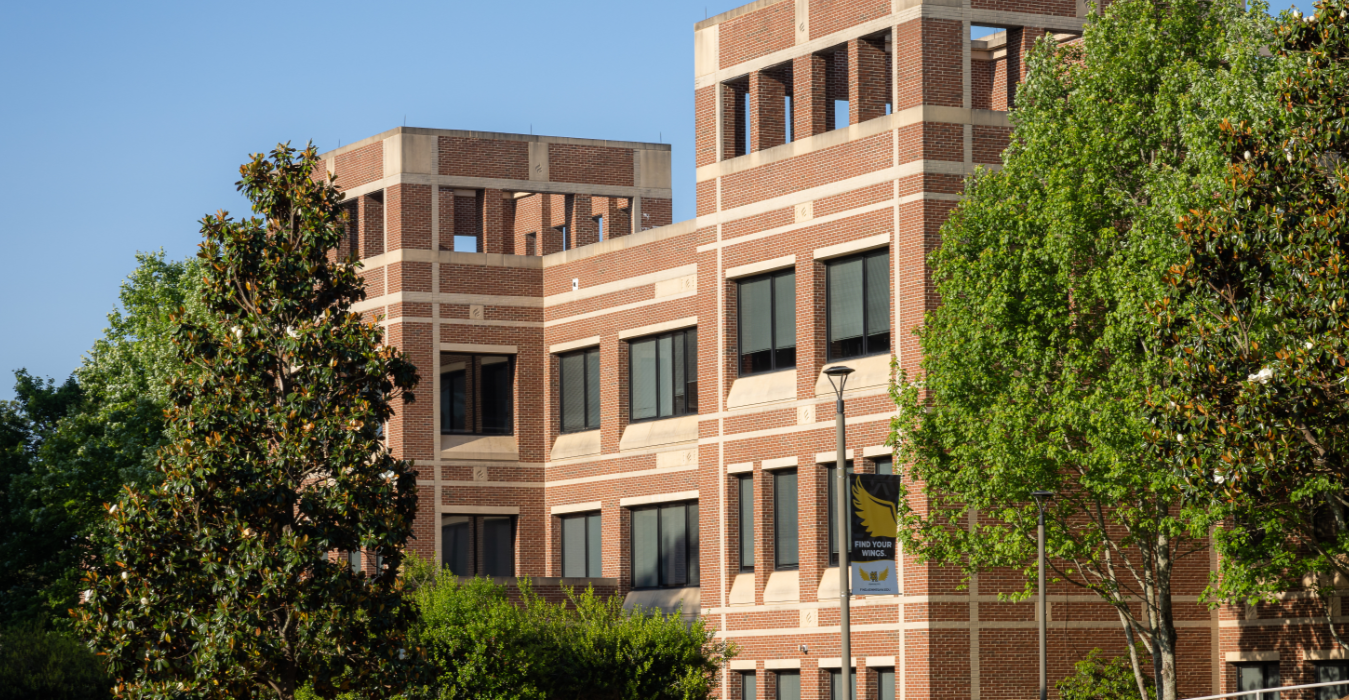
The Marietta Campus Atrium Building, where the KSU College of Computing and Software Engineering is housed, on May 11, 2022. [Photo: Judith Pishnery / Kennesaw State University]
As the presence and capabilities of artificial intelligence continue to grow, it becomes increasingly important for the next generation to be knowledgeable and prepared. AI is advancing at a rapid pace, and Kennesaw State University has recognized the need for a program that will allow its students to adapt to this uncertain future.
In August 2024, KSU students were able to begin the school’s first-ever Master of Science in AI. Nearly two years later, KSU announced in February 2026 that it would be the first school in Georgia to offer a Bachelor of Science in AI.
Following this new announcement, KSU students in the AI master’s program and developers of the AI bachelor’s program have spoken up about this field of study. Many are advocating for the importance of the program and explaining who can benefit from pursuing a degree in artificial intelligence.
Program developer Dr. Bobin Deng claims AI is the future
Several professors, like Dr. Bobin Deng, believe the program is important because artificial intelligence “is the future.”
Deng graduated from the Georgia Institute of Technology and did work in Silicon Valley for a year before joining KSU in 2022. He is now an assistant professor of computer science, and he is one of the main developers of the new AI bachelor’s program.
According to Deng, students will be required to take initial core and elective classes. Then, they will be able to choose a specific “path” to better tailor to their interests in AI.
But why should students pursue a degree in AI in particular, especially when computer science degrees have been well-developed for years?
Deng explained that AI cannot be — and should not be — placed into a box.
“Right now, our AI is still focused…[on] your computer,” Deng said. “In the future, AI should not only focus on the computer. It should be everywhere.”
Deng feels strongly that artificial intelligence is the technology of tomorrow. When asked why he believes it’s important for everyone to learn about AI, his answer was simple.
“Because that’s the future, right?” Deng said. “Accept the new technology.”
Master’s program coordinator says not to fear artificial intelligence
Dr. Mahmut Karakaya received his Ph.D. from the University of Tennessee in 2011 and came to KSU as an associate professor in the department of computer science in 2020. Over the last six years, he has worked on computer vision, machine learning and several areas of AI with a focus on biomedical and biometric research.
Karakaya is the AI master’s program coordinator and serves as one of the key developers of the new AI program. He explained that KSU didn’t expect many students during the first year of the AI master’s program, thinking that around 30 students would apply. However, the first semester landed at over 100 students.
“That is one of the motivations. We said, ‘Okay, it looks like the students want to … major in the AI,’” Karakaya said. “‘Why don’t we just go ahead and offer a B.S. in AI?’”
From there, the AI bachelor’s program transformed from an idea into a reality.
Like Deng, Karakaya also believes learning about artificial intelligence can be beneficial to people of all backgrounds. He said the knowledge learned in these programs will be “easy to convert” for many fields.
Many students are still wondering about what exactly the new program entails and its overarching goal. Karakaya explained the program’s purpose and its importance.
“AI looks like…it’ll change our lives,” Karakaya said. “The purpose of the program is preparing students for AI applications. So just developing AI [and] using AI for different…types of applications in the domain.”
Students will first learn the theoretical parts of how AI works and gain hands-on experience in the field. According to Karakaya, students are given projects to work on, developing models and getting data through their own research to expand their skills and knowledge.
KSU Interim Chair Dr. Yiming Ji says students “need this degree”
Dr. Yiming Ji received his Ph.D. in computer science from Auburn University, and he worked as a professor and chair of the Department of Information Technology at Georgia Southern University from 2019 to 2024. In July 2026, Ji was named the interim chair of the College of Computing and Software Engineering at KSU, while simultaneously holding the title of associate dean of the college.
Ji explained that he did not play a large role in the program’s development, but he offered much insight into its current state and why it is a necessary addition to the university.
He said faculty members and courses dedicated to the program have already been decided, and they have started strong in the 2026-2027 school year.
According to Ji, what makes this program unique is that students are required to choose a minor from another field. The goal is for students to learn how to incorporate AI into their selected domain field, whether it’s engineering, healthcare, business or another path.
Like the program’s developers, Ji also believes this program will bring an entirely new area of study that cannot be learned with only a degree in computer science.
“Computer science will still remain extremely important, because think about it: without computer science now, there’ll be no AI,” Ji said. “But on the other hand, AI is a field [that] has been growing so much, and it can be independent of computer science. It can be built above all these existing systems, all these algorithms [and] data structure systems we have already had.”
Ji said that this program comes at a time when AI is developing “faster than ever.” Therefore, he finds the B.S. in artificial intelligence to be pertinent to the future of the university and its students’ success.
“We’re ready to launch this new program because if we don’t do that, we’ll be behind [as] a university,” Ji said. “They need this degree to go out to find jobs, right? If we don’t do it, we miss a great opportunity for students.”
Master’s student says contributing to AI is a “dream” for him
Akifcan Özbulut is a KSU graduate student pursuing a Master of Science in Artificial Intelligence. He is currently working under Karakaya while conducting research on AI in the biomedical field.
Özbulut believes it is important for people invest in AI because it aids in learning how to use data and “make something of it.” He added that this technology plays a helpful role, providing a comparison that brought his point to life.
“It’s a really useful tool…like [the] internet. Internet is useful because it basically helps us to transfer data between us,” Özbulut said. “Internet helps us to transfer [data], and AI helps us to use it.”
However, unlike the new program’s developers, Özbulut would not encourage just anyone to join the program. He said that AI is a “really big field,” and if a student is debating joining the program, they should have a definitive, genuine interest in AI.
“If you really want to do this, you should be decisive about it,” Özbulut said. “I’m doing it because I enjoy it.”
Özbulut described a program that is more than simply information and projects surrounding artificial intelligence. It is a program that also highlights important moral implications surrounding this ever-changing and growing technology.
“In that program, it’s not just about engineering,” Özbulut said. “It’s about…life. How can we implement AI in ethical ways?”
Future of the AI program
As artificial intelligence becomes an inherent part of life and careers, universities like KSU find it necessary to prepare their students for the near future.
While programs like these take an intense dive into this technology, AI is no longer reserved for those pursuing careers in computer science. In fact, as Ji put it, computer science is now the mere foundation of artificial intelligence.
Writers, nurses, doctors, engineers, teachers — practically every career field may soon incorporate AI into its workflow. KSU is simply using this fact, along with AI’s rapid growth, to predict and adapt to what will set their students up for success.
Whether you’re a seasoned computer scientist or have no prior experience in the field, it seems the developers of the new AI program believe there is something to learn for everyone.