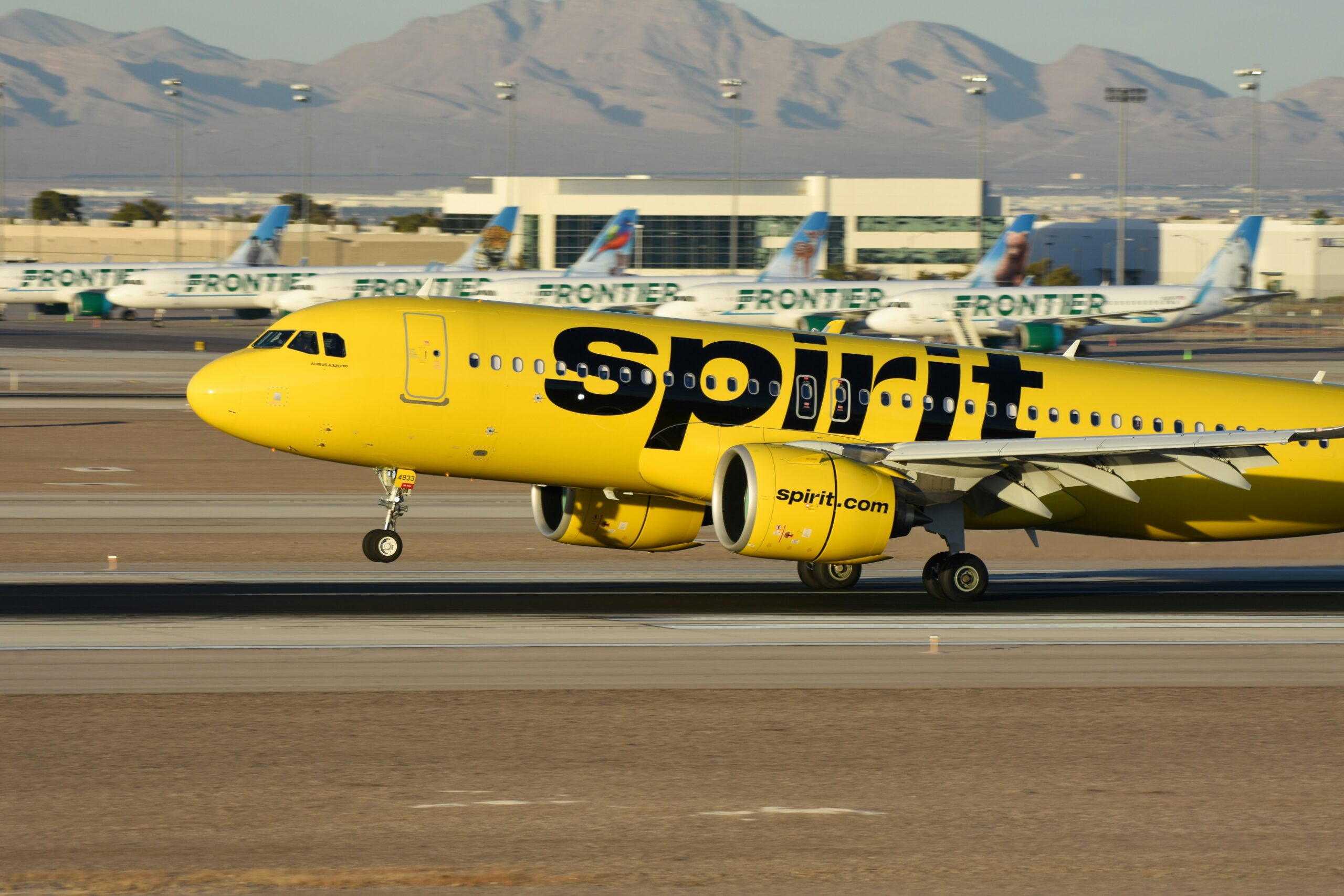
Spirit airlines plane taking off with Frontier airlines planes in the background. Las Vegas, Nev. Febuary 16th, 2025. Photo Credit: David Syphers
Spirit Airlines announced Saturday, May 2 that it was ceasing all operations after failing to acquire a $500 million bailout from the federal government.
Customers with pending flights were told that all flights had been canceled and would receive refunds for purchased flights.
The announcement also explained that all customer service call centers and counters were closed, leaving many refund inquiries impossible to resolve.
Earlier in April, the airline approached the Trump administration with talks of a financial bailout to alleviate skyrocketing fuel prices, but a deal was not reached. Since the conflict in Iran started, aviation fuel prices have almost doubled at $170 per barrel, leading to the subsequent closure of all operations.
While some travelers are immediately affected, the long-term consequences may be more significant.
Spirit Airlines’ sudden shutdown leaves less competition among remaining budget airlines, which in turn could lead to higher fare pricing. Americans already suffering from the economic effects of the Iranian conflict may be hesitant to spend money on increased airfare and choose alternative forms of travel.
To understand why this matters, it’s important to realize the role budget airlines play in the travel market.
Spirit Airlines was one of several companies in the United States that function on the ultra-low-cost flight model, offering minimized luxuries for cheaper flights. These airlines make travel possible for consumers with a low budget.
Among the groups most affected by this shift are college students.
For many students studying far from home, budget airlines are the only realistic option to travel back for holidays and breaks. Their cost and speed are essential for students who have tight academic schedules.
This impact is especially visible at Kennesaw State University, which hosted 2,300 out-of-state students and an additional 928 out-of-country students in Fall 2025.
In the future, these student populations will face higher costs on return flights home. While KSU does offer support to these students through tuition waivers and support centers like the Connected Campus and Trailblazers Hub, travel affordability remains a consistent issue.
Beyond essential travel, many college students rely on budget airline pricing when planning vacations. This allows students to spend more on lodging, activities and experiences.
Rising travel costs may force students to stay closer to home to avoid long car rides or expensive flights when planning vacations.
However, for many students, even leisure travel is becoming harder to justify.
Most students work part-time entry-level jobs that pay near minimum wage, making them vulnerable to inflation. In addition to rising living and tuition costs, many already live on tight budgets.
As travel becomes more expensive, students may have to work extra hours or pick up a second job just to fly home.
Given current financial pressures, students must be more strategic when planning travel. Students should remain aware of changes within the industry and make informed decisions before booking flights.
Additionally, college students should explore other forms of transportation like buses and trains, which are on average cheaper for long-distance travel.
Ultimately, the collapse of Spirit Airlines may be an early warning of deeper instability within the airline industry.
As further strain on the industry continues to grow, consumers can expect to see other budget airlines try to keep themselves afloat with increased prices, reduced services, fewer destinations and a general slowdown across the industry.