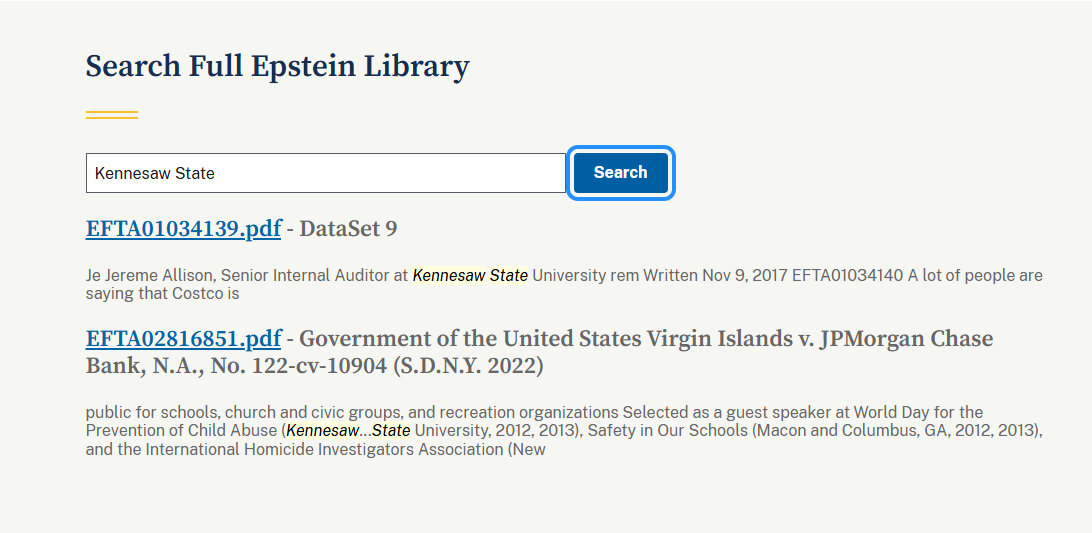
Search query for “Kennesaw State” in the DOJ Epstein library.
The release of court documents tied to convicted sex offender Jeffrey Epstein has reignited national debate.
The Epstein files are unsealed court documents, depositions and contact records connected to Jeffrey Epstein’s sex trafficking investigations. While records have surfaced over several years, a major wave of documents were unsealed in January 2024 by federal court order.
The files stem largely from a 2015 civil lawsuit and include references to politicians, celebrities, and business leaders. Many documents are redacted to protect victims, but the public release has allowed individuals to review primary government records themselves.
Unlike previous high-profile cases that have been filtered through traditional news outlets, the Epstein files have spread rapidly across TikTok, Reddit and X. Many Kennesaw State University students say they first encountered the information on social media before seeking out the documents independently.
A KSU student said he sees significant discussions online but remains unsettled by what he describes as a lack of accountability.
“It’s definitely disturbing,” he said. “My confusion is how the people listed with evidence of wrongful conduct aren’t being punished right now.
His comments reflect a broader frustration among students who view the case as an example of unequal justice.
Another student, Paige Booth, described the release as “dystopian,” citing the number of powerful individuals referenced in the documents.
“Seeing it all and how many people were involved is insane,” she said. “The Presidents involvement and political figures is disgusting to me. It makes no sense how it’s possible to be in a position of power and involved with such grotesque things.”
Paige also expressed concern over what she sees as inconsistent accountability internationally, referencing the scrutiny faced by Prince Andrew in the United Kingdom. She noted that many documents remain heavily redacted and questioned whether media coverage has fully reflected the scope of the material.
Jazmin Nahuaca, another KSU student, said she initially encountered the files through her social media feed but felt compelled to verify the information herself, firsthand.
“I honestly had to stop myself because it was so messed up,” she said. “But anytime it pops up on my feed, I can’t help but listen and then go find the exact file because I want to think it’s made up but then it’s actually true and only makes me feel worse.”
Students interviewed described a pattern: exposure through social platforms, followed by direct engagement with court documents. For some, the accessibility of the files requiring only age verification to view, adds to concerns about how sensitive material circulates online.
The release of the Epstein files represents a rare moment in which members of the public, including college students, are sifting through government documents themselves, rather than relying solely on news summaries and traditional communication outlets.
At KSU, reactions range from anger and distrust of the government to emotional exhaustion, which reflect a generation grappling with transparency, power and accountability in the digital age.