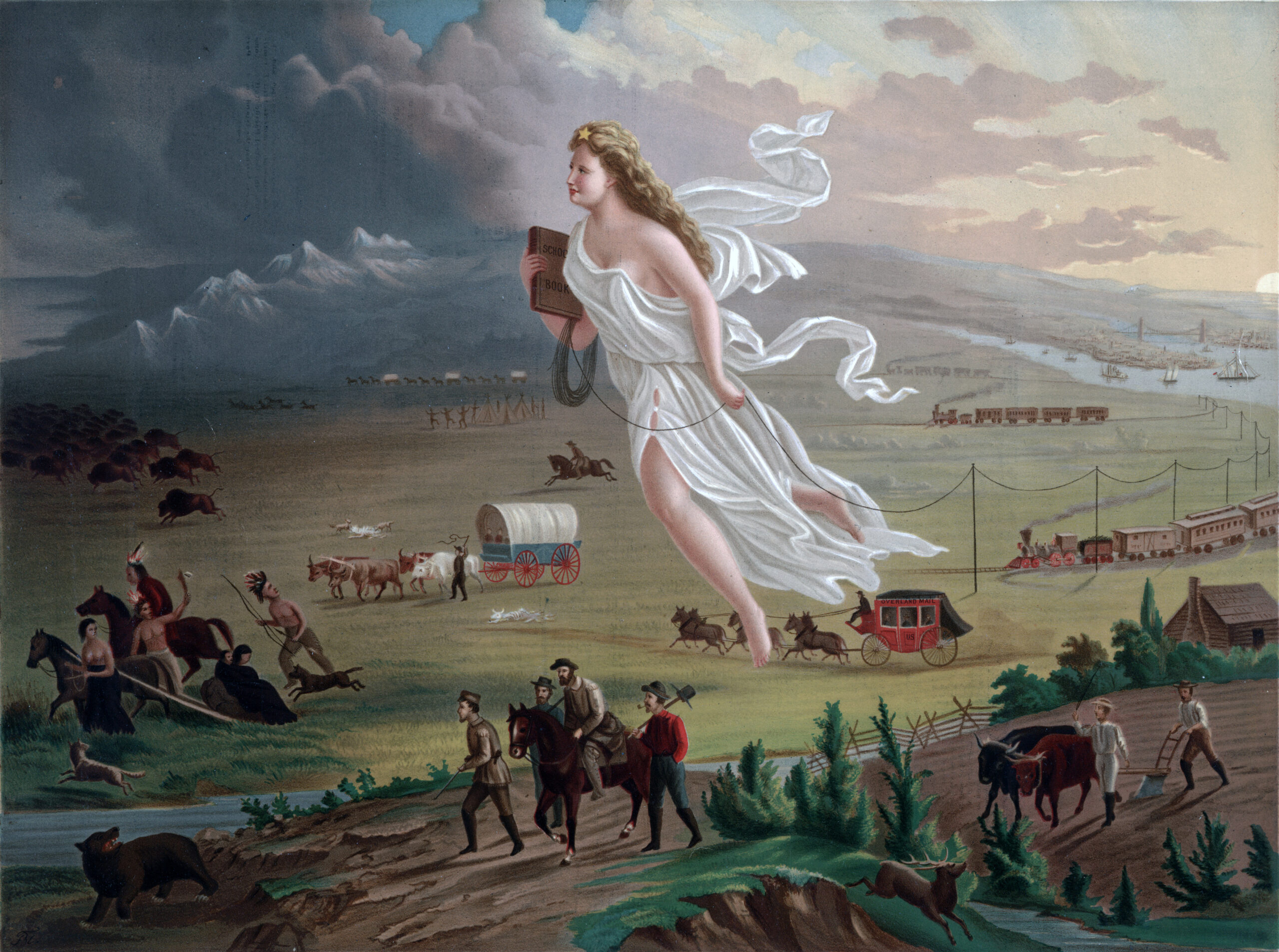
Painting “American Progress”. 1872. Painted by: John Gast
Greenland, Venezuela and Canada are all very different countries with different languages, histories and cultures.
However, the three countries face the same nightmare: becoming a part of the United States.
In 2025, President Donald Trump threatened to “annex Canada as the 51st state.” In January, the U.S. attacked the Venezuelan capital of Caracas and captured the country’s leader, Nicolás Maduro.
Then, as of Jan. 21, 2026, Trump backed away from U.S. claim to Greenland based on national security after making a NATO deal.
All of this shows an increase in U.S. intervention globally and doesn’t even include Trump’s tariffs, involvement in Iran and development plans for Gaza.
Citizens and non-citizens alike would not be shocked if the U.S. was aiming at total world domination. However, there is a point in all this chaos that American citizens do not understand, but that the rest of the world does.
The behavior of the Trump administration is historically American and is part of a tale as old as the United States itself.
No one wants to admit they are the villain of the story, or in the case of Americans, their country. Conquering land sounds too polarizing and contradictory to the country that self describes itself as “the land of the free”.
The idea of the U.S. president mapping out the land and people they want control over sounds cartoonishly evil, but that’s exactly what American presidents have been doing for centuries.
On Jan. 20, 2026, a year after his inauguration day of his second term, Trump posted a picture on Truth Social of a map featuring the U.S. flag spanning over Canada, Greenland and Venezuela.
The picture is allegedly AI-edited from a meeting in Washington in August 2025 when European leaders joined for “Trump’s phone call with Russian president Vladimir Putin,” according to Jordan King, a reporter from Newsweek.
While the map is considered to be fabricated, the post shows that conquering countries is a real daydream for the current president. A dream that no country shares but has happened too many times to count.
United States intervention in Latin America is not new. The 1823 Monroe Doctrine established the American position of opposing foreign influence in the entire western hemisphere, not just U.S. soil.
Following the doctrine, the U.S. occupied Nicaragua in 1856, where American citizen William Walker acted as president of Nicaragua for a year.
The U.S. also controlled Haiti’s political and financial interests from 1915 until 1934 and occupied the Philippines from 1898 until 1948.
More recently, the U.S. occupied Iraq from 2003 until 2011 and waged war in Afghanistan for more than 20 years following the 9/11 attacks.
These are only some examples of U.S. intervention, but it demonstrates how imperialism has historically been an American ideal.
Even more concerning, it is a purposeful neglect of the American education system that the U.S. occupation of other countries is not widely or extensively taught.
This lack of education is why American citizens today view the Trump Administration’s aggressive foreign policies as new and why people around the world make fun of the lack of cultural competency in the U.S.
If an American citizen wants to be a global citizen, understanding why other countries are not shocked by the Trump Administration’s action is important.
It’s not easy to admit that U.S. citizens are taught imperialist propaganda.
Still, Americans need to look at credible sources on U.S. history that is not taught in schools. This can come from a local library, museums and websites from academic institutions. Lastly, and most importantly, they need to listen to what people outside the U.S. are saying through news sites and social media.
The United States is an imperialist machine, and it takes effort to protect your mind from falling victim to that system. Supporting the sovereignty of other nations against the Trump Administration starts with the education of U.S. citizens.