Photo Credit: US Department of Energy. Tape robot for storing large amounts of scientific data at Fermi National Accelerator Laboratory. Aug.15, 2013.
Artificial intelligence has changed the world in only a few years, entirely reforming several industries along the way.
Many people tend to think of industries surrounding finance, education, manufacturing and even healthcare when they consider how AI is changing the workplace. However, creative industries like animation and music are being impacted in equally profound, yet very different ways.
Creative professionals are experiencing the impacts of AI in ways that are unique to the field—and often deeply disheartening.
How AI drains the “warmth” from man-made music
Music was once a specialized craft, and its creation required a talent only few possessed. Now, anyone with the internet can be the next Beethoven with a little help from AI.
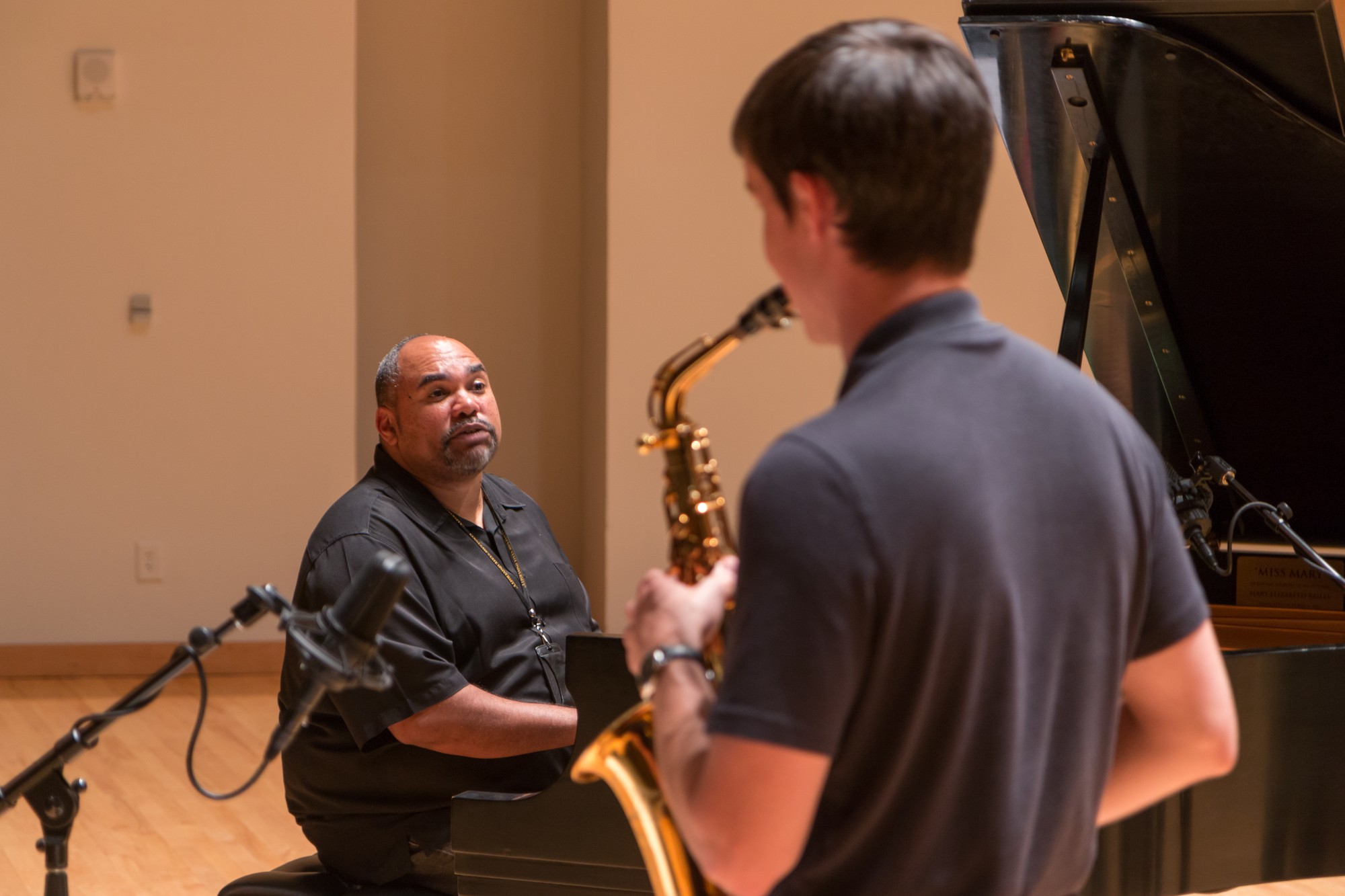
Professional violinist and music history professor Edward Eanes, Ph.D., said that he has already experienced the impacts of AI on his field.
Eanes teaches at Kennesaw State University, where he is the area coordinator for musicology and the general education coordinator for music appreciation. He is also the concertmaster of both the Georgia Symphony Orchestra and the Carrollton Symphony Orchestra.
Eanes explained that the ease with which artificial intelligence can create music can be disheartening. The meticulous skills and man hours that were once needed to create a beautiful sound are fleeting.
“You don’t have to be trained in music at all. You just have to know how to work the technology, and it will do all the work for you,” Eanes said. “That’s kind of a bummer because we go to school and get trained to do all this… do you really have to have a degree in music?”
AI and aspiring musicians
The rapid implementation of technology into the music industry has led Eanes to believe that young musicians should be open to learning about and utilizing AI in the field.
He said aspiring musicians, particularly freelancers, need to learn how to incorporate AI into their work now to increase their chances of success later.
“Be prepared,” Eanes said to future musicians. “You’re going to be competing with the AI.”
“AI should not rule the industry,” says Eanes
Although AI can be a useful aid to music production, Eanes stated that it should not rule over the industry. He explained that man-made music puts real passion and “charm” on display, whereas music assisted or generated by AI seems more “robotic.”
He warned about losing the genuine characteristics of music to the overuse of artificial intelligence.
“If we want to use [AI], it shouldn’t…take over,” Eanes said. “Ideally, we’ll figure it out as a society so that we’re not losing a lot of what we don’t want to lose: humanity and warmth and personality.”
Overuse of AI takes the “magical charm” out of animation
AI-generated animation has grown increasingly common, and any average citizen can now create cartoons.
These drastic changes in the world of animation leave many professional cartoonists feeling uncertain. Some animators see AI as an assistant to their own work, while others see it as a content machine.
For this reason, many professional animators are torn about the use of AI in their field.
Chris “Kilika” Malone is an Emmy Award-winning cartoonist and an assistant professor of animation and illustration at Kennesaw State University, where he also serves as the coordinator of digital animation. Malone also worked as an animator for many TV shows, including FX’s adult cartoon “Archer” and TruTV’s comedy series “Adam Ruins Everything.”
Malone acknowledged that AI opens new doors for animation, as it can do several tasks that humans simply cannot. He said that the use of AI only becomes a detriment when it attempts “to replace the human element” of animation, but it can be a useful tool when used in moderation.
Malone said that artificial intelligence is “definitely overused” in animation, from visuals to voiceovers. According to Malone, many studios are now attempting to replace human animators and voice actors in the name of saving money.
However, saving money and rushing production does not mean the animation will be good quality, he explained.
Rookie animators and GenAI
While Malone views AI as a helpful tool in some cases, he stands firm that rookie animators should still learn how to animate the traditional way. AI is not yet capable of creating the dynamic movements or expressions that truly bring animation to life the way that human cartoonists can, he explained.
He described the role of the “12 principles of animation:” a dozen aspects of man-made animation that add a “magical charm” and more advanced visuals to cartoons.
The principles include aspects like “Anticipation,” which Malone described as the wind up before an action, such as a baseball player stepping before taking a swing. According to Malone, these 12 characteristics enable man-made animation to be more enhanced than AI-generated animation, as AI cannot yet implement these principles well.
“The 12 principles of animation are what allow us to connect with the animation,” Malone said. “The ‘anticipation’ isn’t just because it looks good. It communicates… it’s a story.”
He also said that learning how to animate the traditional way brings a sense of passion to the craft, and new animators need to experience this feeling.
“Passion is what allows your audience to connect with [an animation],” Malone said. “If there’s no passion in making it, why would an audience be passionate about watching it?”
“Demoralizing”: AI’s true impact on animators
Malone holds an ambivalent view of AI. It could be a helpful tool to improve animation, but it could also cost the humanity, art and charm of animation.
It all depends on how society chooses to use it.
“[GenAI] is a novelty for people who are not animators, but for the animators themselves it’s…disheartening, demoralizing,” Malone said. “It is changing how people who are not animators interact [with] and view the craft.”