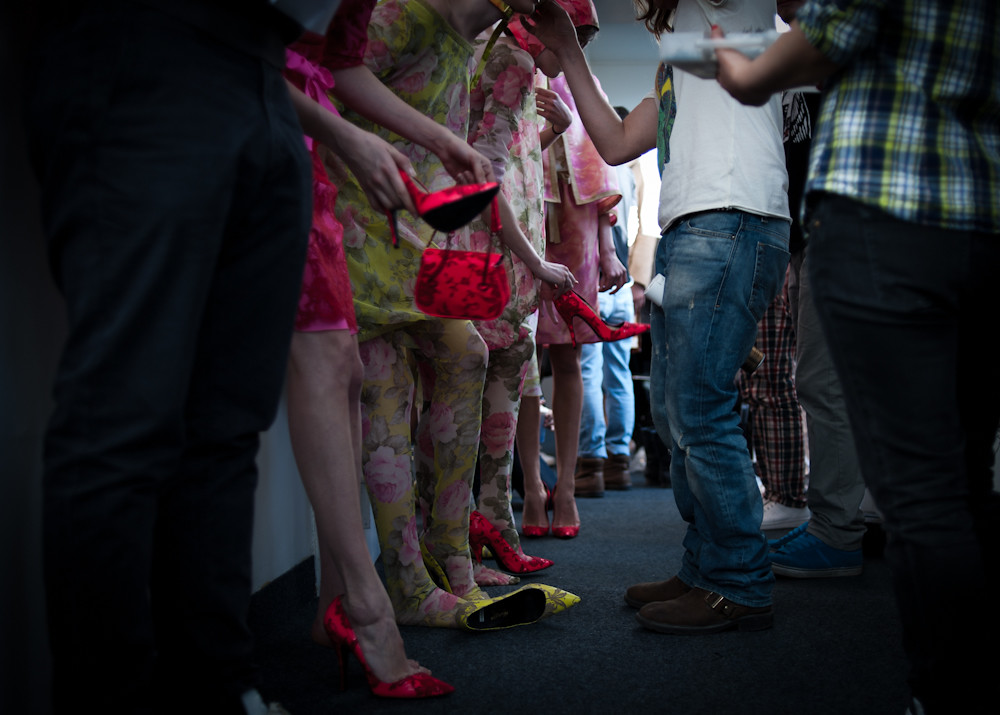
A group of models holding red high heels. Photo Credit: Valeria Castillo
A new chapter unfolded across the fashion world as creative directors took over legacy houses and redefined their identities. This season’s collections showed that the future of fashion is being written by those who are unafraid to challenge tradition.
The recent fashion week season marked a turning point for several of the industry’s biggest houses. A new generation of creative directors is stepping into roles of leadership and redefining how heritage brands can balance history with modern identity.
From Paris to Milan, designers reimagined what luxury looks like in 2025.
Designer Glenn Martens brought raw emotion and craftsmanship to the French luxury fashion house, Maison Margiela. Designer Demna’s arrival at Gucci sparked curiosity about the house’s future, and designer Matthieu Blazy breathed new life into Chanel with movement and material mastery.
These three designers’ debuts captured the fashion landscape in transition. They displayed the collision of legacy and innovation on the runway.
Glenn Martens at Maison Margiela
Martens was appointed creative director of the French fashion company in January 2025, succeeding John Galliano. His debut was an Artisanal collection for fall/winter of 2025-2026, and it was very theatrical.
He utilized upcycling, masks, dramatic textiles, decaying textures, layered surfaces, and it gave strong nods to the brand’s heritage with his own twist.
This fashion season in the Paris Fashion Week calendar, the designer had his “ready- to-wear” debut. This show leaned to more wearable clothes compared to his past Artisanal show. He blended Margiela’s signature touches with asymmetry, distressed denim/leather, dresses and trench coats.
The masses praised Martens’ for his ability to balance spectacle with a sense of emotions. They loved the way he followed some of the fashion houses traditions while still blending in his personal style and experimentation.
There was, however, a lot of criticism revolving how he went about his ready-to-wear collection.
People believe that he should have been a bit more daring given how he debuted his Artisanal collection. Several comments were made on the mouth pieces that symbolized the brands’ logo of the iconic four stitches. Many believed that they were used to distract people from the clothes and bring more attention to the accessories.
Demna at Gucci
Demna, most known for his work at Balenciaga, was appointed as Gucci’s new artistic director in March 2025 to take over for Sabato De Sarno. His first collection for Gucci is titled “La Famiglia,” which was released by a surprise lookbook ahead of Milan Fashion week.
The designer revived many of the Gucci staples, like bamboo bags and horsebit accents, and mixed them with his signature broad silhouettes, leather and archival nods.
A lot of people see Demna as a promising reset for the fashion house, and many appreciated that he has not attempted to replicate his Balenciaga style at Gucci. He has implemented more polished and wearable elements that match Gucci’s clientele. This move increased store traffic for the luxury brand, which is thought to be one of the main reasons he was brought over.
On the other hand, it was believed that his renewal will not turn into long-term growth for the company. His addition has even been considered a gamble for Gucci.
Demna having the show as a lookbook may have been a safe move for him, given the absence of an emersion factor during an in-person shows.
Matthieu Blazy At Chanel
Blazy was appointed as the Chanel Creative Director in December 2024. His debut collection was presented in October 2025 for the spring/summer 2026 collection. There was a lot of anticipation for this collection, and he delivered a masterclass of fabric manipulation and world-building.
There were many hints of Blazy’s work at Bottega, such as several of the signature silhouettes making an appearance.
There were a lot of details and deep-digging in this show. The opening looks were a direct homage to Coco Chanel and how she dressed back when breaking barriers in the industry.
Blazy’s debut felt like a new chapter for Chanel, bringing in freshness to the lines. Many praised the collection’s raw edges, knit silks and dynamic silhouettes. This will expand Chanel’s creativity, allowing for more freedom within the fashion house.
Some questioned, however, if Blazy’s voice will be strong enough to step out from the former creative director’s shadows since Chanel had a long history in the industry. It was also thought that he went too far for the typical Chanel buyer with his avant-garde touches.