
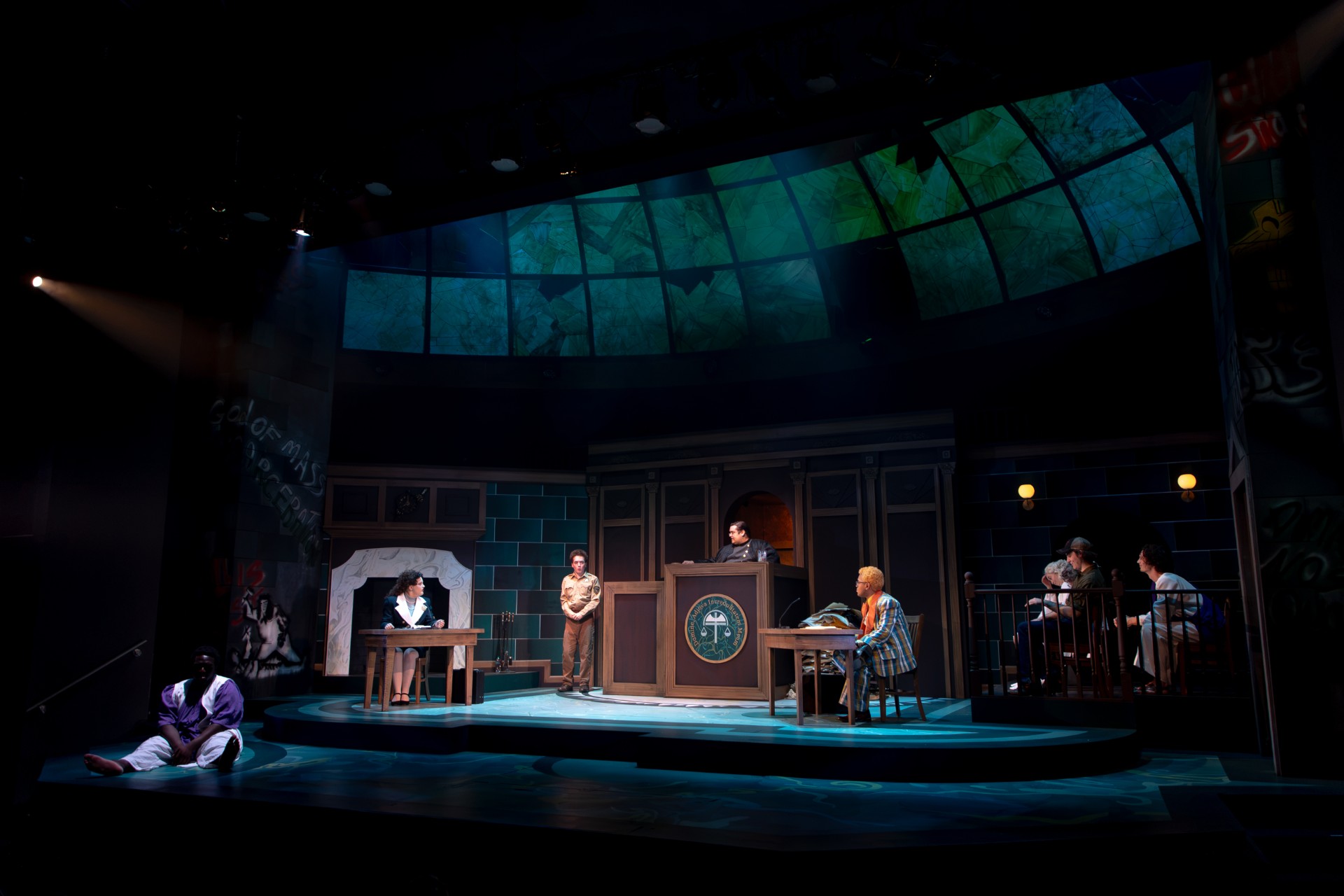
The trial of Heaven v. Judas Iscariotcommences in the Geer College’s production of The Last Days of Judas Iscariot. Photo credit: Casey Gardner Ford.
The Geer College of the Arts has opened “The Last Days of Judas Iscariot“ at the Stillwell Theater.
Written by Pulitzer Prize-winning playwright Stephen Adly Guirgis, “The Last Days of Judas Iscariot” first premiered off-Broadway in 2005. Guirgis wrote the play to make religious themes more accessible to a wide audience. He told the KSU dramaturgy team that Catholicism was full of “thees and thous,” so he penned the play with the language of those around him in New York City.
The play, set in a courtroom in Purgatory, follows the trial of Heaven v. Judas Iscariot.
Spunky defense lawyer Fabiana Aziza Cunningham and smooth-talking prosecution lawyer Yusef El-Fayoumy spend the show dishing out whether Judas should be in Heaven or Hell. They bring famous witnesses to the stand, such as Satan, Sigmund Freud, Caiaphas, Pontius Pilate and Mother Theresa.
Lyndsey Morgan anchored the tense scenes with her portrayal of the angel Gloria and Mother Theresa, while Elisa Bethea made audiences audibly gasp with her monologues as Henrietta Iscariot. As jury members Loretta and Butch, Lee Bertram and Talen Bortz steal the show with their expressions and reactions.
Sadie Nance and Sarvesh Shankar keep the show rolling portraying lawyers Cunningham and El-Fayoumy. In a show with so many monologues and lots of back-and-forth banter, the two never fail to inject personality and charm into each line.
The dual-casting of multiple characters provides a challenge for an actor, but each performer stepped up to the plate. It is an ensemble cast that is not to be trifled with.
Ultimately, the show poses difficult questions on morality, religion and ethics. It questions how culpable Judas was for betraying Jesus of Nazareth in Gethsemane. Was Judas’s sin of betrayal forgivable? How does intent interfere with the consequences of our actions? And who decides what is just and fair?
For director Jacqueline Springfield, these unanswerable questions are exactly the point.
“I’m hoping that [the play] makes people laugh, that it makes people think,” Springfield said. “[I hope] it poses some questions that don’t necessarily have answers…and causes people to ponder it so they’re talking about it long after the play is over.”
Springfield called the production one of the “biggest puzzles” of her directorial career, but she is proud of the work the students have done both on and off the stage.
“I’ve seen [the students] grow tremendously,” she said. “Everybody as a person has grown so much.”

Judas Iscariot (Anthony J. Newkirk) and Jesus of Nazareth (Nate Carson) argue after the tense courtroom proceedings. Photo credit: Casey Gardner Ford.
From the beginning of the play, Judas Iscariot sits catatonic in the corner of Purgatory’s courtroom. He says nothing and stares into the distance. It is haunting, like a ghost looming over the court proceedings. For actor Anthony J. Newkirk, this stillness was the most challenging aspect of the role.
“[The play] has taught me how to just be still and take in the world around me,” Newkirk said. “I think because…I’m stationary on stage, it causes my other senses to heighten.”
Newkirk is at his best as Judas. It takes a skilled performer to convey emotion through silence and stillness. His Judas is a flawed, multilayered and empathetic man.
Lingering among the jury, Jesus of Nazareth spends most of the show silently observing the trial and its wacky ensemble. There is a power in the character’s unspeaking presence, and a vulnerability that challenged Jesus’s actor Nate Carson.
“Accepting [the role of Jesus] has been one of the hardest roles I’ve had to take on as an actor, but with that, it’s the most rewarding,” Carson said. “[But] through all of that, I also found a deep love for acting again that I had lost in previous years.”
In a show full of elaborate scenes and sensitive topics, Jacqueline Springfield does an incredible job of guiding the performers through such touchy subjects.
The lighting, set and sound design stands out as among the highest caliber produced by the theatre department. It is haunting to watch fog twirl in and out of broken glass windows and have each gavel hit echo through the theatre. Applause is due for technical director Daniel Terry and lighting & audio supervisor Steven Love, as well as their team of student assistants and designers.
It is clear that every part of Last Days was a labor of love.
“The Last Days of Judas Iscariot” plays at the Stillwell Theater from Nov. 5 to 15. Tickets are available online and in person.

