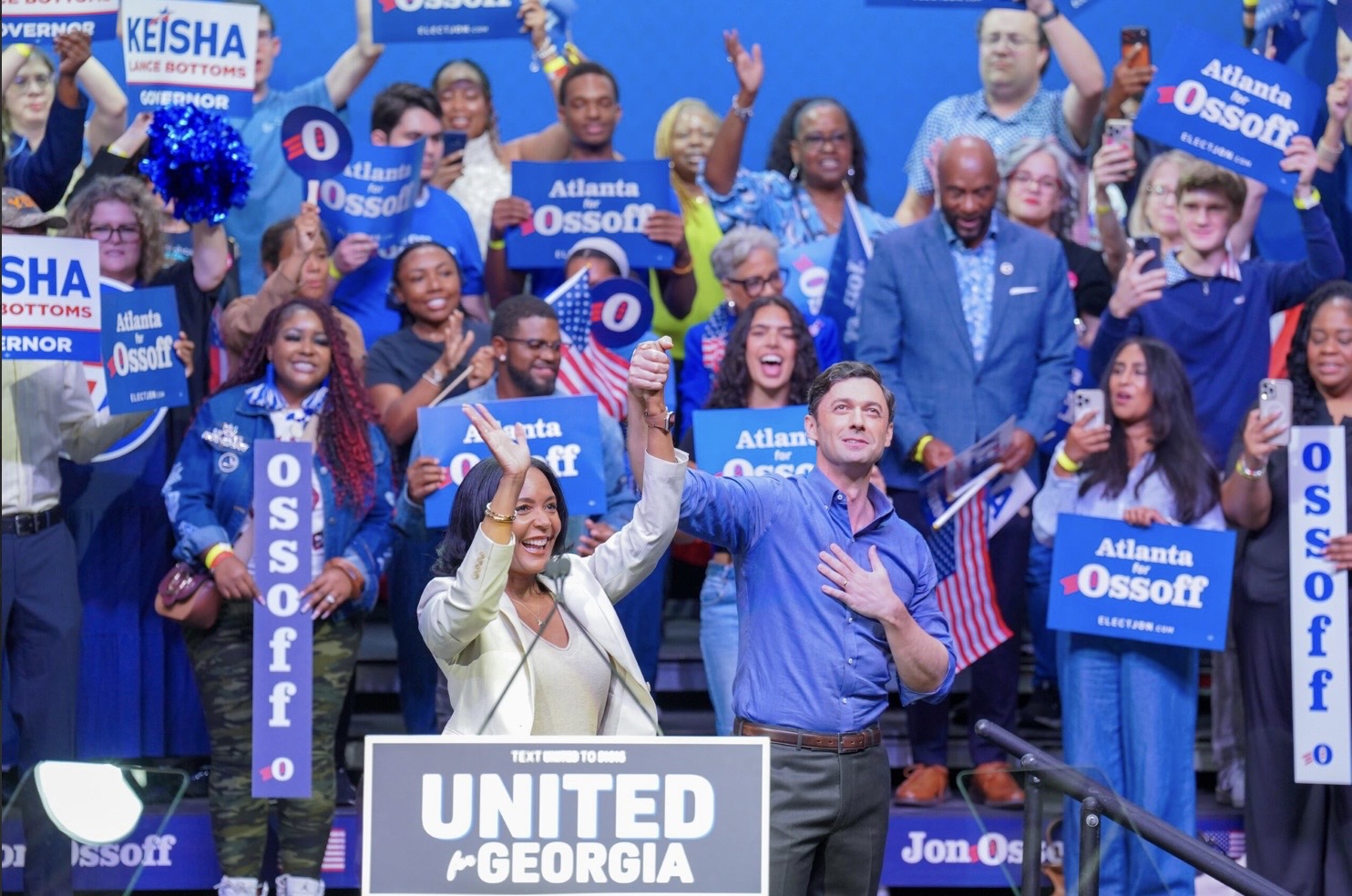
Keisha Lance Bottoms and Jon Ossoff joint rally Atlanta, Ga June 2026. Photo credits, Karen Lopez
Georgia’s election results sparked mixed reactions among Kennesaw State University students, with some expressing hope for political change while others questioned whether the outcome would make a difference.
The Nov. 3 midterm elections brought a major shift in Georgia’s political leadership. Democratic U.S. Sen. Jon Ossoff won reelection, defeating Republican challenger Mike Collins with 59% of the vote. Democrat Keisha Lance Bottoms defeated Republican Rick Jackson with approximately54% of the vote, becoming the first Black woman elected governor in the United States.
Democrats also won every statewide office on the ballot and secured a narrow majority in the Georgia House of Representatives for the first time in more than two decades. Republicans retained control of the state Senate, creating a divided legislature.
For Samaria Mitchell, vice president of the College Democrats of Kennesaw State University, the results represented an opportunity for Georgia to move in a different direction.
“I was absolutely blown away with the results of the election,” Mitchell said. “I love that we as a state decided it was time to do what’s best for the people that reside here.”
Mitchell said the results gave her hope about the country’s political future, but added that elected officials now need to demonstrate they can govern effectively.
“I think all we need to do now is wait for the newly elected people to prove they can govern effectively,” Mitchell said.
That expectation comes as Democrats prepare to take control of several state offices previously held by Republicans. The party’s victories included the governor’s office, attorney general and secretary of state, among others, ending decades of Republican control over Georgia’s statewide elected offices.
For KSU student Marie Pasi, the election’s significance extended beyond party control. Bottoms victory was part of a historic night for Black women in Georgia, with eight Black women winning statewide races.
“As a black woman, to see people who look like me in such positions makes me ecstatic,” Pasi said.
Pasi said she has faith that the women elected will prioritize the people they represent, regardless of their differences.
The results also reflected a shift in voter support across Georgia. More than 2.8 million Georgians cast ballots during early voting, setting a midterm record and accounting for about 34% of the state’s registered voters, according to the Atlanta Journal-Constitution. The early-voting electorate was younger and more diverse than in previous midterm elections, though those figures do not indicate how voters cast their ballots.
Not all students viewed the results as evidence of lasting political change. KSU student Elijah Moulder said he believes voters regularly turn against whichever party is in power, creating a cycle that does not necessarily lead to meaningful improvements.
“Soon in two years the people will be tired of the democrats, so they’ll vote for the republicans again,” Moulder said.
Moulder also questioned whether either major political party prioritizes the needs of everyday Americans, saying he believes neither party wants to help the public.
The different reactions raise questions about what motivated voters and whether the results reflect support for a particular political agenda.
Dr. Eric Castater, associate professor of political science and international affairs at KSU, said the results suggest many voters were responding to dissatisfaction with President Donald Trump and the Republican Party rather than supporting a specific alternative.
“The vote seems to be more of a response against Trump and the Republicans rather than for a clear alternative,” Castater said.
Castater pointed to national issues, including the war with Iran, tariffs and rising prices, as factors that may have influenced Republican losses. He also identified immigration policy, concerns about voting rights and perceived corruption within the Trump administration as contributing factors.
He said public confidence in political leadership remains low across both major parties, reflecting a broader pattern of voter dissatisfaction.
Castater also discussed the shift in younger voters support for Republican candidates between the 2024 presidential election and the 2026 midterms. He said Republicans performed worse with young voters in 2026 than they had since at least the Obama era.
“This big 2-year swing clearly suggests that younger voters are dissatisfied with the status quo, but I’m not sure it tells us much more about their attitudes,” Castater said.
As Georgia’s newly elected leaders prepare to take office, students expressed different expectations for what comes next. While some see an opportunity for political change and greater representation, others remain uncertain whether a change in leadership will lead to meaningful improvements.