
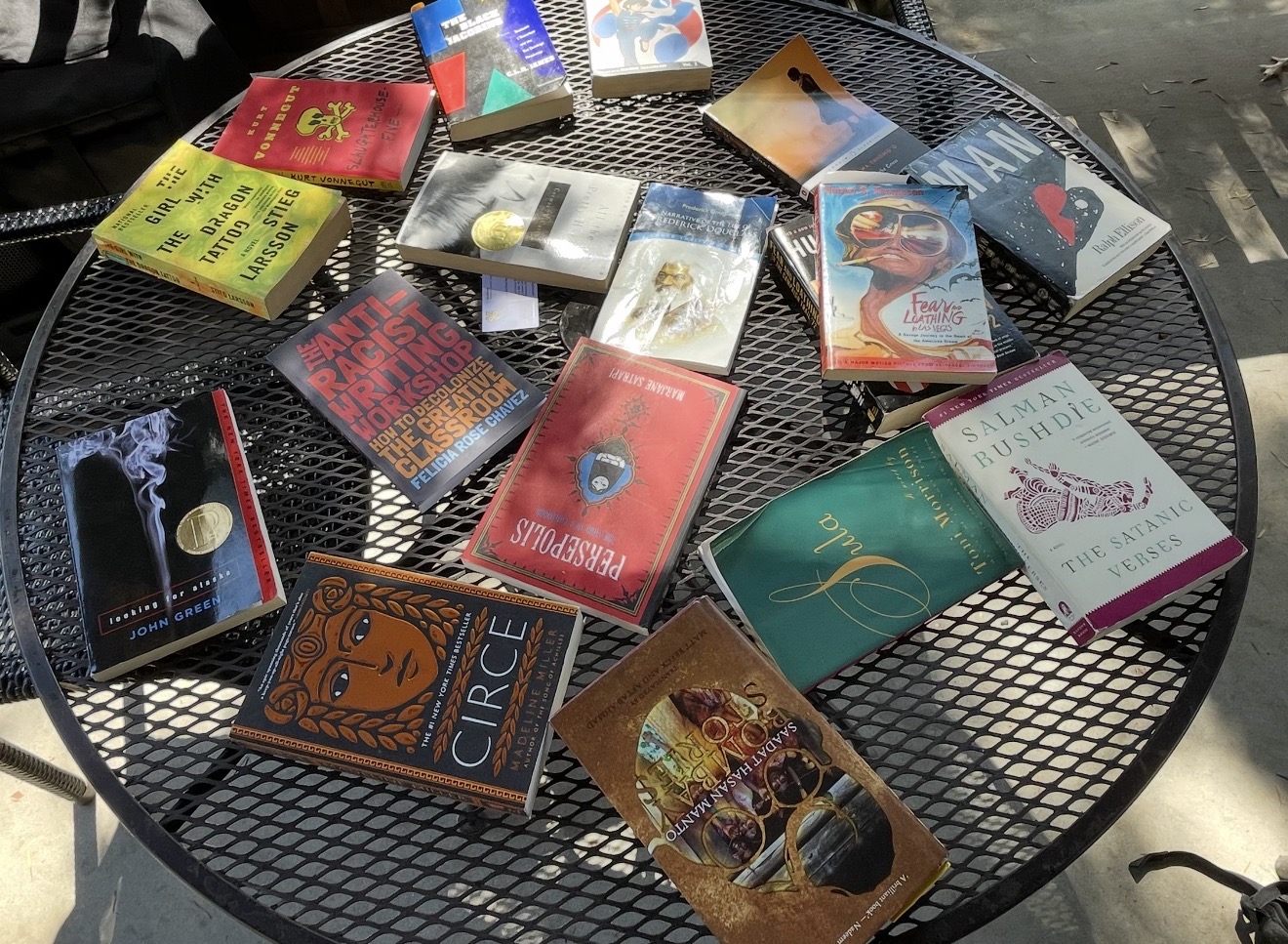
English department staff hosted a banned book reading at the Legacy Gazebo to invite students to discuss banned and challenged books as a part of KSU Banned Books Week 2026.
“This is part of a larger Banned Books Week, which is observed much more broadly than just at KSU,” said Professor Michael Rumore, an English lecturer who traveled from the Marietta campus to host the event.
Banned Books Week took place from Oct. 4 to Oct. 10. It is a nationally recognized annual event that was launched by the American Library Association in 1982. The theme for this year was “Let Books Be. Protect the Freedom to Read.”
KSU’s 2026 Banned Books Week is a yearly event sponsored by the Department of English, Interdisciplinary Studies and World Languages and Literatures. The Legacy Gazebo reading was the final of three events that week.
“We’re trying to increase awareness around challenges surrounding [banned books],” Rumore said.
More than 20 students attended the event, coming and going between classes.
“I came out because my professor offered extra credit for attending,” said Zahna Issa, a freshman Integrated Health Sciences major. “I felt as if this was the best event for me to attend.”
Though some students attended the event with the desire to receive extra credit for a class, they walked away getting a lot more out of it than they thought they would.
“Originally, this was an extra credit assignment that my English 1102 professor provided,” said Shiloh Collins, a freshman Nursing major. “But after coming to the event today, I feel like I took away a lot more from the event than I expected to.”
“I thought this was an interesting topic to come and discuss,” Issa said. “Because some of the themes surrounding the banned books were interesting to me.”
Banned books that were discussed during the event included “The Bluest Eye” by Toni Morrison, “Looking for Alaska” by John Green and the “Narrative of the Life of Frederick Douglass” by Frederick Douglass.
“‘The Bluest Eye’ was my favorite book that we discussed today,” Collins said. “We were relating that book to current events that have been happening over the past few weeks.”
“The Bluest Eye” repeatedly landed on the American Library Association’s top 10 most challenged books due to “sexually explicit material,” “lots of graphic descriptions and lots of disturbing language” and “an underlying socialist-communist agenda.”
“There was a banned book about sex trafficking that we discussed,” Issa said. “I found it relevant to current times because Atlanta has repeatedly had an issue with sex trafficking. It’s important that we have access to books that discuss those topics and how to address them.”
“When we take away literature instead of giving people the option to read it, you’re oppressing that person’s ability to learn,” Collins said. “As somebody who connects with books a lot, I feel like reading books that have challenging topics can help people to become more empathetic.”
“The youth should be allowed to learn fully about [banned books],” Issa said. “If you don’t know about past history, history will repeat itself again. Not only that, but the children of the world will not be as educated as they should be on certain topics as they get older.”
“Everyone that was here had great points and contributions,” Professor Rumero said. “Even if just one person got something out of this, I would consider this a success.”
The success of the event inspired consideration for future events about other types of banned media.
“One of the projects I want to do next year is a banned music party,” Professor Rumore said. “Look out for that next year. A banned music dance party is on the radar.”

