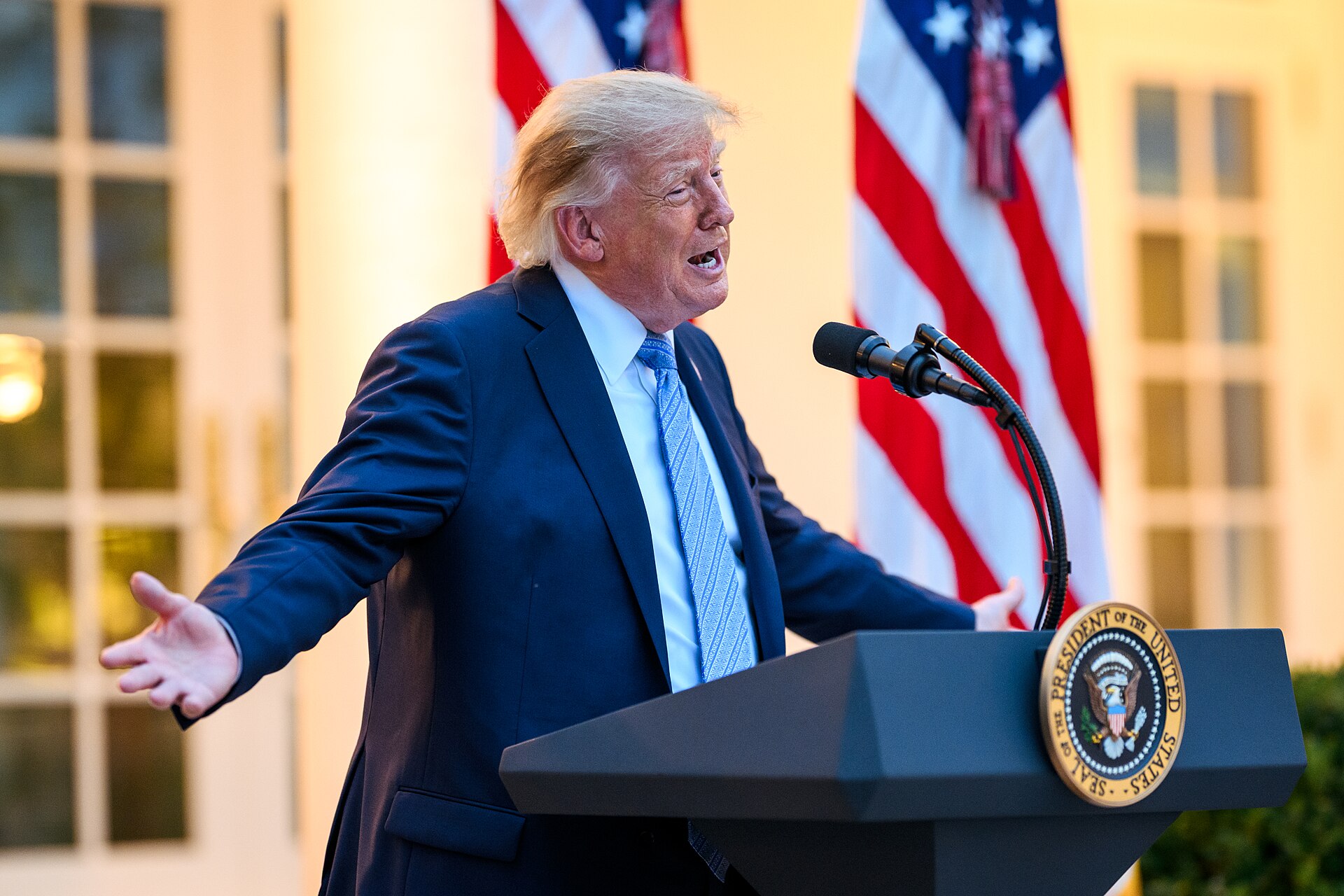
President Donald J. Trump hosts a Rose Garden Dinner for America’s hunters and fishermen while announcing new Executive Orders, Sep. 17, 2026. (Image Credit: Joyce Boghosian).
At the GOP’s first midterm convention in Dallas, President Trump pledged to give every adult citizen $5,000 if the Republican Party maintains control of the U.S. House of Representatives and Senate after the November midterms.
Time magazine estimated the “Trump Dividend” would cost around $1.2 trillion.
In a Fox News interview, Vice President JD Vance suggested the payments could be funded through tariff revenue. However, the federal government has collected about $167 billion in tariff revenue, far below the roughly $1.2 trillion estimated cost of the proposal.
KSU students echoed concerns about how the payments would be funded and what the pledge could mean for elections.
“First of all, how’s he going to get this money?” said Jace Freeman, a junior political science major who describes himself as a centrist. “That money has to come from somewhere.”
Freeman also said the pledge sets a bad precedent.
“It sets a precedent that there’s a monetary attachment to an election outcome, which is very daunting,” he said. “We never want that because it’s also a sign of corruption.”
Nathaniel O’Neill, a senior history major who said he is a registered Democrat, agreed with Freeman.
“I feel like the promise, the unilateral promise of $5,000 if Republicans win is kind of like open-faced bribery,” O’Neill said.
Sergio Garcia, a senior history major who said he is a registered Democrat, said the money would not go far.
“Let’s say we did all get $5,000. We’re already having to pay extra for gas, for groceries, for pretty much everything. It basically would have been effectively nothing,” he said.
Not all of the skepticism came from students who identified as centrist or left-leaning. Abhay Shetty, a sophomore political science major who describes himself as generally conservative, questioned whether the pledge aligned with the values of his party.
“Donald Trump is part of the Republican Party. He’s supposed to be fiscally conservative, fiscally responsible,” Shetty said. “He’s not supposed to give free handouts.”
The belief that Trump’s pledge contradicts Republican values was echoed by Jason M. Shepherd, a part-time assistant professor of political science and former chair of the Cobb County Republican Party.
“Republicans have spent decades criticizing large federal spending programs, deficits, inflationary stimulus and politicians attempting to buy votes. Democrats can now use precisely those arguments against them,” Shepherd said. “If voters view the pledge as implausible, it could reinforce the perception that campaign promises are essentially disposable.”
Eric Castater, an associate professor of political science and international affairs, said in an email that the pledge would hurt most Americans if enacted.
“It would be a net negative for the vast majority of the population,” he said. “Pumping over $1 trillion in debt-financed money into the economy would drive up inflation/prices further, lead to additional increases in interest rates and perhaps result in money leaving the country as a weaker currency and growing government debt spooks investors.”