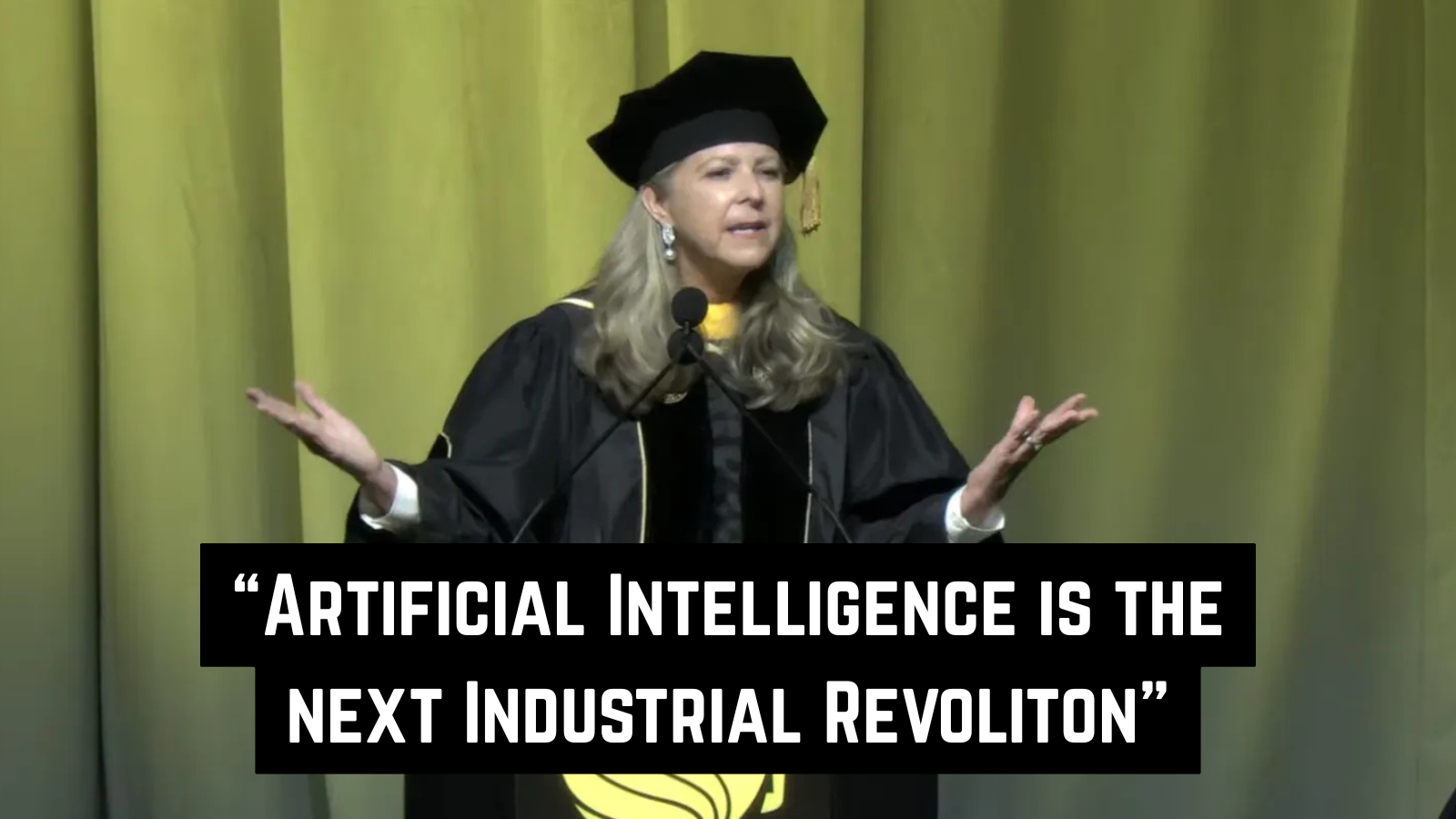
University of Central Florida speaker Gloria Caulfield talks about AI at university commencement. May, 2026. Photo Credit: University of Central Florida
Commencement speakers at college graduations across the United States used their platform to praise Artificial Intelligence (AI), touting its development to the class of 2026.
Real estate development executive Gloria Caulfield, who was asked to speak at the University of Central Florida’s commencement, called AI the “next industrial revolution.”
Glendale Community College incorporated the technology by using a new AI system to announce graduates’ names; however, the program skipped over hundreds of students.
Thousands of graduates are outraged in response to speakers’ comments on AI and the use of it in their graduation ceremonies.
Google CEO Eric Schmidt, who spoke at the University of Arizona’s graduation, was booed by the crowd for minutes on end.
From the beginning of each semester, students are told that if they use AI to help them with their assignments, they will be penalized or expelled.
So, why is the administration, and even faculty, okay with using it for instances like these?
The class of 2026 is one of the first generations to grow up and witness the development of AI. More than anyone, they should have a say in it being a part of their future careers.
It is distasteful to take away such a special day from students, a day that is meant to signify the beginning of the rest of their lives, and use it to push narratives about generative technology that poses a threat to education.
Students already have to worry about the possibility of AI taking over their jobs, so to have it explicitly praised at their graduation is a slap in the face to all they have accomplished.
Is the trend of AI-focused commencement speeches a coincidence, or is there something bigger going on behind the scenes?
These colleges are all saying the same things about AI. They argue that it is a revolutionary tool and that students must make it work for them in order to adapt to the future of the economy.
These speeches could be a segue for incorporating AI into future university graduations and academic learning.
However, based on the negative reactions from thousands of students across the country, it could be difficult to achieve this goal.
It is clear that the younger generation is less lenient towards AI compared to older generations, and because of this, there will be pushback against AI in workplaces and academia.
College administrations need to take this negative feedback from students into consideration and do better for upcoming graduating classes.
No matter how revolutionary AI becomes, it did not put in years’ worth of hard work to walk the stage and receive a diploma. AI will never replace the passion students have for their future careers.