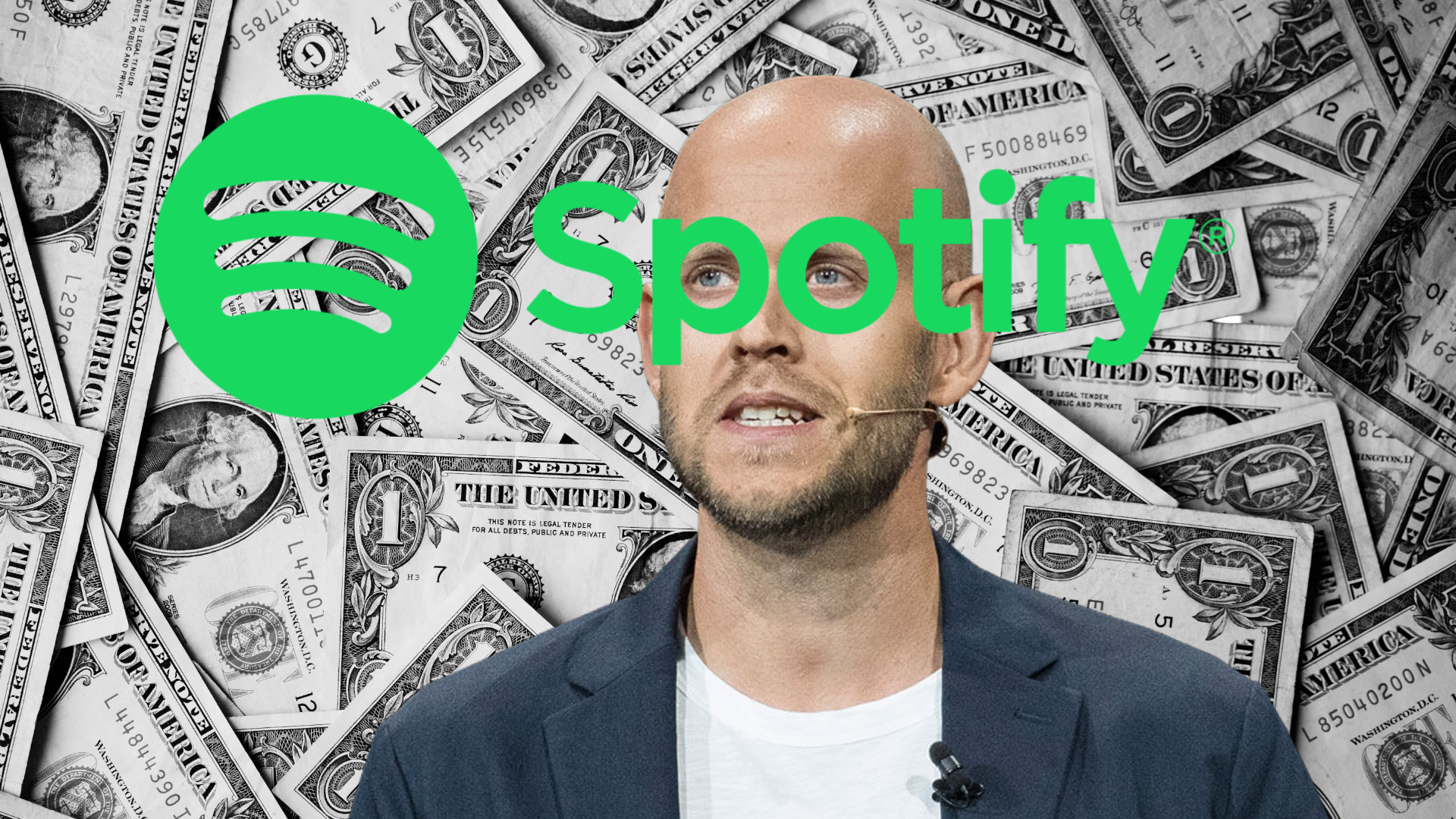
Spotify CEO Daniel Ek standing in front of money with Spotify logo. Photo Credit: Tye Brown/The Sentinel
Spotify, in the mass vacuum of hyper-commercial business ideologies, is the primary offender of anti-consumerism.
A series of controversies and problematic business models has greatly altered the platform’s image, transforming it from an accessible beacon of immeasurable content to one of the world’s greediest media titans.
Its first main offense to music is its predatory business model designed to squeeze bank accounts and drain wallets.
Since July 2023, Spotify has issued three major price increases on its monthly subscriptions. These price increases have brought the most popular of Spotify’s subscription plans—the Premium Individual subscription—from $10.99 to $12.99.
The most egregious pricing change has been the platform’s Family Plan subscription. What was originally priced at $16.99 in early 2024 is now $21.99.
Affordability is simply no longer on Spotify’s side. Platforms such as Apple Music and YouTube Music maintain a baseline individual plan fee of $10.99 that Spotify has since strayed away from.
Still, the pricing of subscription plans is only a fraction of the problem that’s causing users to look elsewhere for music-related endeavors.
Lurking in the thousands of public playlists inside the web player are countless songs created entirely by Artificial Intelligence (AI).
In 2025, controversy sparked over “The Velvet Sundown,” a band with seemingly no proof of existence.
Over the course of just a few short months, the artist account had garnered over 1.4 million monthly listeners. The account’s published music began to circulate among many users’ Discover Weekly roundup, blending in with other contemporary legitimate music acts.
On X, the artist’s social media description reads, “Not quite human. Not quite machine,” seemingly in response to the widespread uproar around the band’s major publicity.
On July 5, 2025, the account revealed in an Instagram post that the band was an AI-generated “synthetic music project.”
This is just a specific example of the integration of AI music on Spotify.
A moderator on DjangoBooks, a message board for all things art, voiced their opinions on the inclusion of AI music in the platform’s playlists.
“[The Spotify algorithm] auto-plays some related content that is not a real artist but some auto-generated garbage. This stuff ranges from mediocre to abysmal. It’s really ruining the platform.”
On a different note, Daniel Ek, Spotify’s founder, is notorious for leading investments into a military strike drone company, Helsing.
As recorded on June 17, 2025, Helsing raised $693.6 million in funding. The leading investor was Prima Materia, a venture capitalist firm that Ek founded in February 2021.
Helsing, which began as a company primarily focused on developing artificial intelligence software, expanded its manufacturing capabilities and started constructing aircraft, drones and submarines.
In light of both the Russo-Ukrainian war and the Israel-Palestinian conflict, these investments are proving to be extremely controversial as the world enters an increasingly hostile environment.
For notorious music critic Anthony Fantano, the identity that Spotify represents is corporate and out of touch.
“There are sides to this dichotomy, and [Spotify executives] are on a particular one, and it’s the side of the rich, of the powerful and the well-connected.”
Music, although becoming more widespread via the internet, is in its most volatile state.
Business executives upcharging subscription fees, platforms removing their most beloved features and the push of music made entirely by AI is crippling the music listening experience.
Switching from Spotify is ultimately more than just changing your favorite music listening platform. It’s a change that preserves the purpose of art in a commercial world.