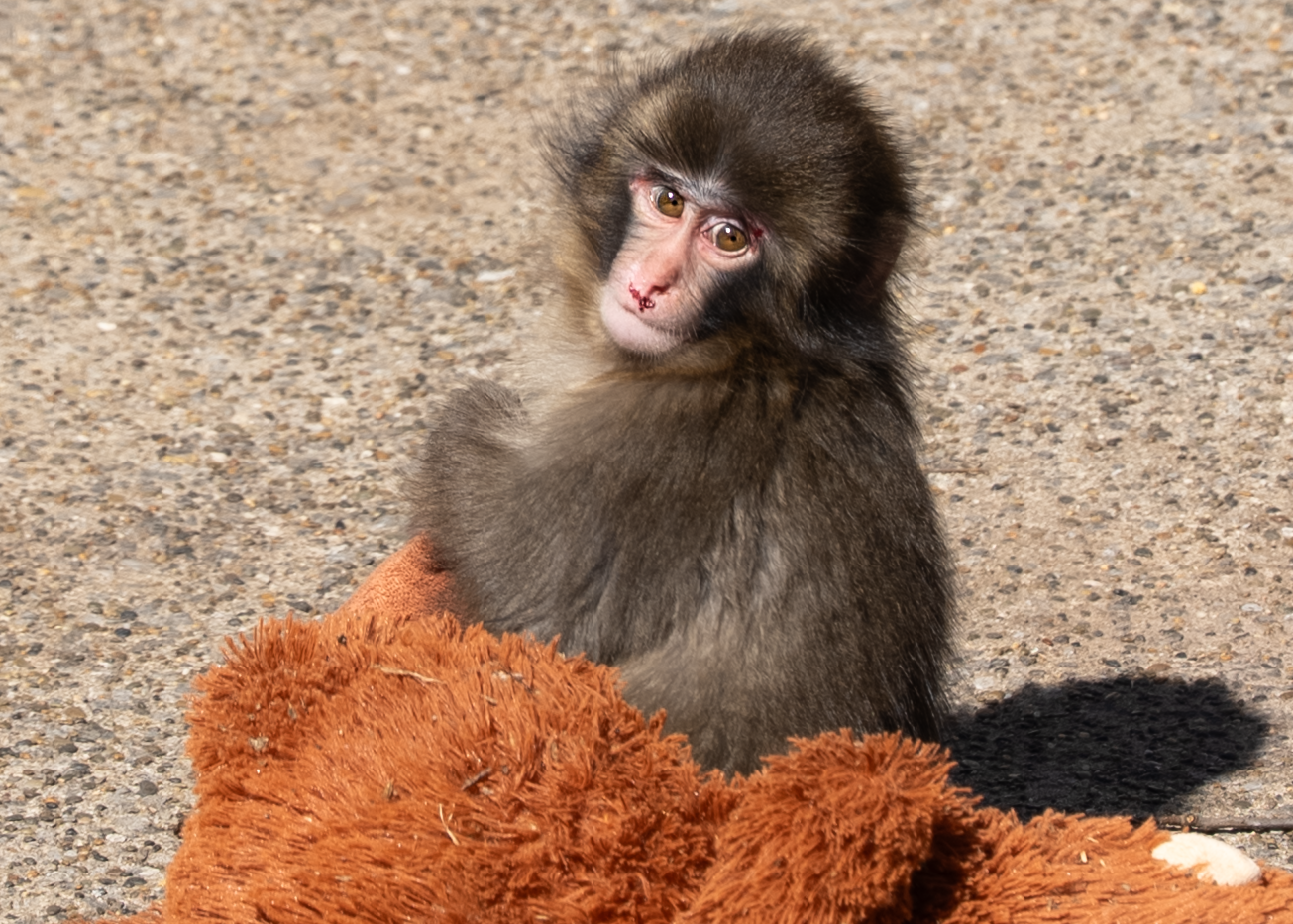
Photo Credit: Daiei Onoguchi. Punch with his plush in Ichikawa Zoo. March 7, 2026.
Punch, or “Panchi-kun” as he is referred to in his home in Ichikawa City Zoo, is a 7-month-old Japanese Macaque monkey who took the internet by storm.
Macaques, the same genus of monkeys utilized in the infamous cloth/wire mother experiment, heavily prioritize relationships and comfort, something that makes Punch’s story especially captivating — he does not have a mother.
Abandoned by both his biological mother and fellow monkeys shortly after birth, the zookeepers at Ichikawa City Zoo sought to solve the dilemma by giving Punch an Ikea stuffed animal of an orangutan to substitute his lack of comfort. Seeing footage of Punch clinging to said stuffed animal, people online lost their minds.
Society is not unfamiliar with the concept of animals as spectacle. Take, for example, previous social media trends such as “Moo Deng,” or even the existence of zoos in general.
While it could be assumed that the intense attention and selective empathy currently being given to Punch may fade with the rise of another baby animal for those to ogle over, it is not without noticing the inherent issues that Punch’s situation happens to shed light on.
It is natural for the initial reaction to Punch’s plight to be one of sympathy or even being able to directly relate. Almost everyone has felt misunderstood at least once in their lives, and many have faced scrutiny and ostracism for simply being different than others.
“I think it is really interesting that people have become so attached to a monkey because they see themselves in its loneliness,” says Kennesaw State University student Rei Pavlovich.
Another KSU student, Kota Cook, shared the same sentiment, saying, “In this current climate, I think maybe everyone fawning over a cute little monkey is what we need.”
People feel solidarity, affection, and sympathy towards Punch. However, there is a question that must be asked that many have not bothered to consider: Why exactly is Punch being treated like this?
Zoos: Savior or Saboteur?
While there has been no professional observation or study following the case of Punch the Monkey, it is possible that the psychological phenomenon known as “zoochosis” may play a part in little Punc’s struggle to fit in.
Zoochosis refers to the distress that many animals face when forcefully placed in the foreign land of captivity. When experiencing the effects of zoochosis, animals have been observed to typically be much more anxious and aggressive, even more so than they would be inclined to be in their natural habitat.
KSU student Molly McAvoy shared her take on the matter.
“I see it similar to society,” McAvoy said. “Do you think because of the system we are in, we are bound to create a kind of class divide where we think of people as lower than us? I think that’s what happened with the monkey — because they’re in the cage, they’re bound to do this.”
Is it the natural behavior of the Macaques themselves, or are external factors such as the unnatural environment of the animals’ enclosure causing them to treat poor Punch with increased apathy?
Whatever the answer may be, those who claim to be fans and supporters of Punch should be aware of the grisly reality at the core of the internet’s current favorite animal.