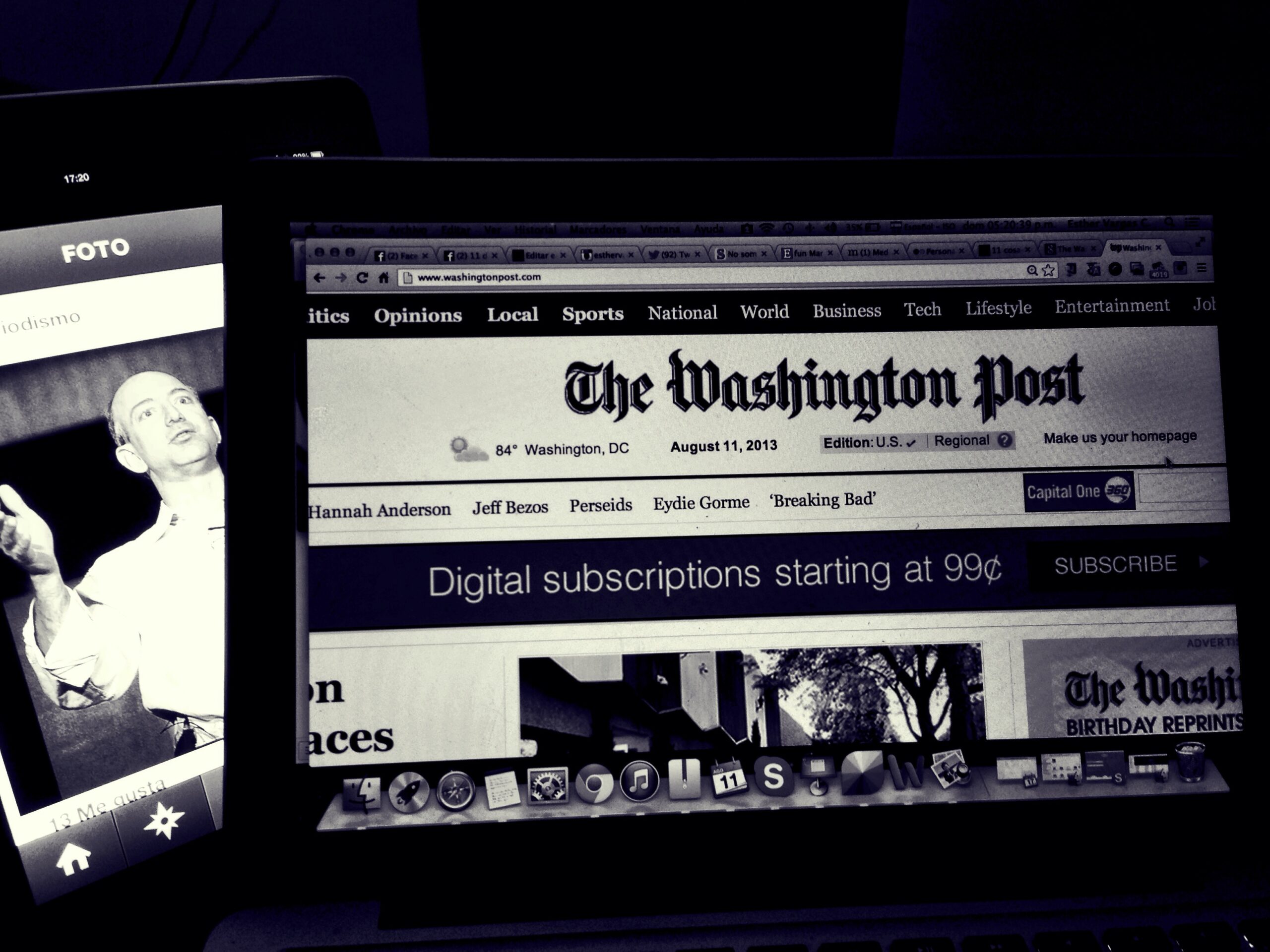
The Washington Post website and a photo of Jeff Bezos. August 7th, 2013. Photo Credit: Esther Vargas
For many years, The Washington Post represented the gold standard of American journalism. This reputation was built from scratch by hundreds of reporters committed to truth and accuracy, guided by the paper’s slogan “Democracy Dies in Darkness.”
These days, however, it seems The Post is determined to put out its own light.
On Feb. 4, 2026, The Post announced that it would be laying off 300 employees, about one-third of its staff, citing financial struggles as the reason for the cuts.
Entire sections of the paper were gutted, including sports, books and more. Amid the backlash to these cuts, The Post’s CEO and Publisher Will Lewis announced his resignation on February 7.
The cuts are the latest in a long line of missteps made by Lewis during his time as CEO.
Lewis’ time at The Post had been a tenuous one.
He was personally appointed CEO by the paper’s billionaire owner Jeff Bezos in November 2023 to replace former CEO Fred Ryan, who stepped down that August.
Before Lewis had even stepped into the role, he was already embroiled in controversies of his own at The Post.
Within a year, Lewis announced that The Post would fully embrace generative AI in its newsroom and break decades of tradition by not endorsing a presidential candidate in the 2024 election.
Famously, Bezos himself killed an editorial piece that would have endorsed Democratic candidate Kamala Harris over Donald Trump. This incident alone cost The Post about 250,000 subscribers, about 10% of its 2.5-million-person reader base at the time.
Bezos also announced via X in early 2025 that The Post’s opinion section would shift to writing “in support and defense of two pillars: personal liberties and free markets.”
In his post, he wrote, “There was a time when a newspaper, especially one that was a local monopoly, might have seen it as a service to bring to the reader’s doorstep every morning a broad-based opinion section that sought to cover all views. Today, the internet does that job.”
While these incidents are outrageous, it is Will Lewis who facilitated these changes.
In his short time as CEO, he transformed The Post into a vehicle for all the news and opinions that align with Jeff Bezos’ personal beliefs.
In his resignation letter, Lewis said, “I want to thank Jeff Bezos for his support and leadership throughout my tenure as CEO and Publisher. The institution could not have a better owner.”
Bezos’ not-so-subtle encroachment on The Post’s reporting is becoming increasingly obvious, and readers are rejecting it.
Unfortunately, the only people who will be affected by this are the journalists themselves.
For example, Lizzie Johnson, a Ukraine correspondent for The Post, found out she had lost her job in the middle of a war zone.
Frustratingly, this is somehow the same paper that Bob Woodward and Carl Bernstein used to expose the Watergate scandal in 1972, ultimately culminating in the resignation of Republican President Richard Nixon in 1974.
If Watergate were to happen today, Bezos would kill the story to appease his Republican friends, and Woodward and Berstein would be out of a job.