
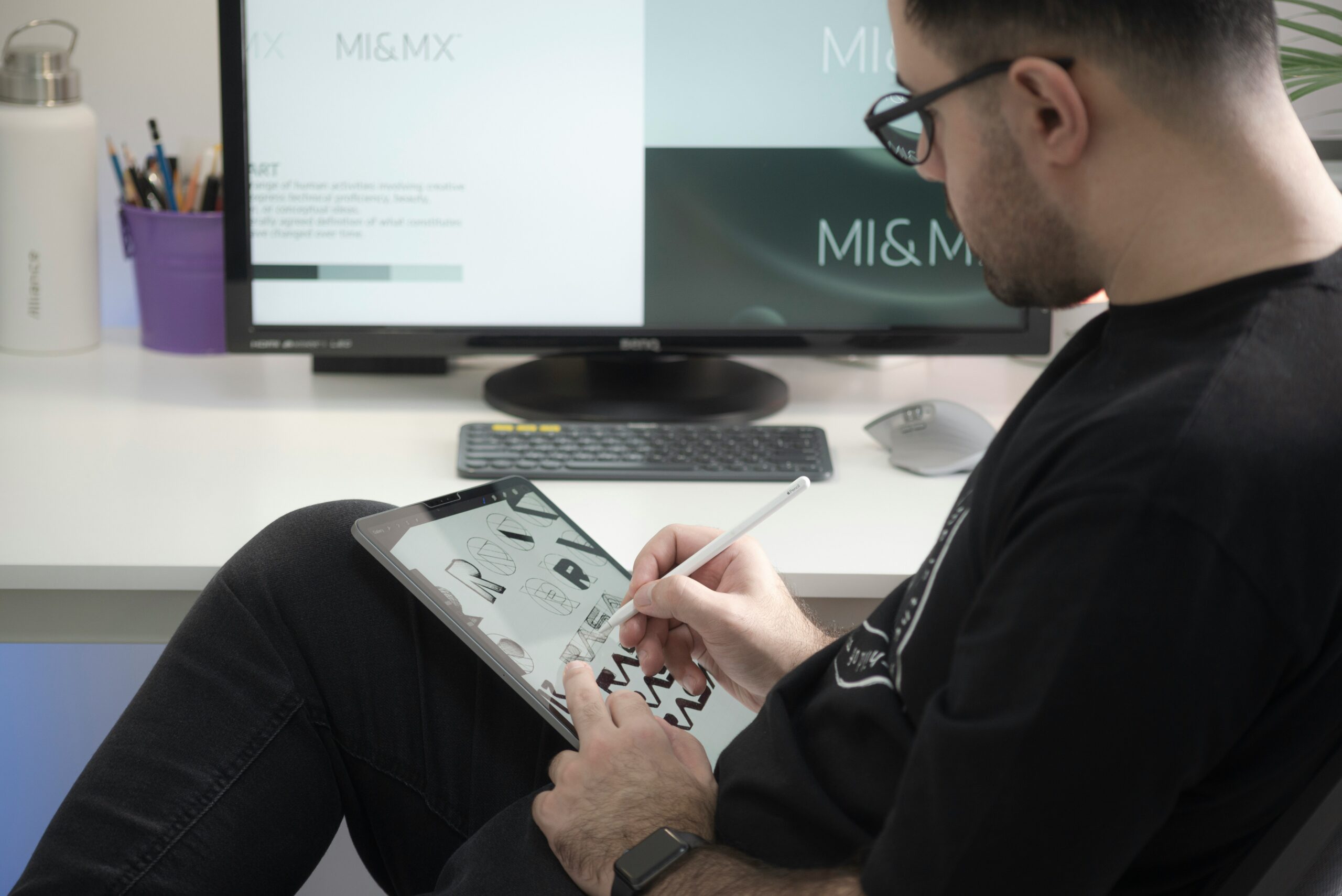
Photo Credit: Milad Fakurian on Unsplash. Man drawing on tablet in-front of a computer. May 13, 2021.
AI: A helpful or hurtful tool for writers?
In a world where artificial intelligence is becoming increasing prevalent, creative students are feeling both concerned and hopeful as it creeps into their fields of work.
Creative students—those in writing, graphic design, music and more—are growing uneasy about AI. It lies in a grey area for many artists, both posing a threat to their livelihoods and presenting opportunities for more efficient work.
Large Language Models, or LLMs, are a type of Generative AI (GenAI) that use external data and code to generate complex text that often mimics that of humans.
Below is a real example of an AI-generated text I asked ChatGPT to produce.

The writing ability of ChatGPT does not require an author comparison, however. Here’s what happens when you give AI a vaguer prompt.

Seems like the world doesn’t need journalists or writers. Why read this whole story when artificial intelligence can summarize the main idea in only five sentences?
Kennesaw State University student Jessica Reyes-Barahona shares these same thoughts and concerns.
Advantages and disadvantages of AI in creative writing
Reyes-Barahona said that AI can be both a good and bad thing for creativity, recalling her experience using it in her own writing. She noted that she did not necessarily want feedback or want AI to rewrite her work but rather see how it responded to questions about her writing.
AI can work as a tool to enhance a writer’s decisions, she explained. However, the overuse of AI crushes creativity and independent thinking.
“It can be useful for creativity in this sense without relying on it to do the writing, but instead to inform decisions you’re making as a writer,” Reyes-Barahona said. “However, it’s clearly being used…well beyond those means, as I often run into people where it seems like they can’t even think for themselves without consulting AI.”
Furthermore, she said that AI becomes a problem as writers depend on it when they hit a wall. She said some writers “don’t think they could do the work it takes by themselves,” so they rely on artificial intelligence to take over instead of challenging themselves to exercise their creativity.
A concerned, yet hopeful outlook
Reyes-Barahona is also a student assistant at the campus’ writing center, and she is pursuing professional editing and publishing. She shared her concerns about the rapid development of AI and its impact on her future career. She claims AI “threatens” many editorial positions, and the field’s increasing reliance on it can be unnerving.
However, she remains very hopeful about her future.
“I do have those fears the more AI continues to develop and the more we integrate it into our world,” Reyes-Barahona said. “However, the hope I hold onto is the many accounts from professors and professionals already in writing and editing fields that don’t feel AI will replace humans in these fields.”
She explained that many positions in writing and editing have already outlasted AI far longer than many expected.
“The publishing industry specifically is something that has lasted well beyond the means of what people thought it would last,” Reyes-Barahona said. “It’s been able to keep up with the age of technology that favors social media, movies, TV, and other visual media and entertainment.”
According to Reyes-Barahona, famous publishing companies like Penguin Random House are taking measures to keep human writers’ and editors’ jobs safe from AI. However, she also recognized that AI will likely be a permanent part of her field.
“[AI] probably will simply become something we’ll have to learned to work around, whether we like it or not,” Reyes-Barahona said.
A complex role: AI in graphic design
Artificial intelligence plays a large role in many graphic design platforms, such as Adobe. It suggests design ideas, creates randomized colors palettes and even generates visuals based off simple text prompts−a particular function that graphic designer Gabriela Sanchez is opposed to.
Sanchez is a sophomore at Kennesaw State with a passion for graphic design. She takes on graphic design projects in her spare time, and she feels that AI has a complex impact on the field.
“I see AI as both a good thing and a bad thing regarding graphic design, or with any other digital artistic form, for that matter,” Sanchez said. “I see it as both a great tool and something that, depending on its use, can quickly turn into a detrimental thing for us creatives.”
The benefits of AI in graphic design
Sanchez explained that AI can be extremely useful for graphic designers when used correctly. She said many of the AI-powered tools make tasks that were previously time-consuming, like background editing and resizing images, much more efficient.
She said that these functions create more time for her to focus on “different and more creative work” during her projects. She noted that graphic design artists can often be under tight deadlines, so AI tools that increase efficiency bode well in her field.
“It’s helpful when I can change the style, fonts and colors of a whole design with various elements with a click of a button instead of having to select each component one by one,” Sanchez said. “It helps when I’m under time constraints and have to show my designs within a specific timeframe.”
She also discussed AI’s ability to generate ideas and create design mockups, noting that it can come up with ideas even when the human brain grows exhausted, stressed or lacks inspiration.
The detriments of AI in graphic design
While AI has enhanced graphic design in a plethora of ways, Sanchez was transparent about the negative impacts it can have when graphic designers grow an overreliance.
“It can be a very thin line between using AI to brainstorm…new ideas and relying on it so much that it completely replaces creative thinking,” Sanchez said. “AI shouldn’t replace one’s critical thinking and problem-solving skills.”
Sanchez added that this replacement of creative thinking can lead to a depletion of a graphic designer’s overall ability to be creative over time. She said that it is a matter of how the artist uses AI and how frequently they implement it into their work.
“Relying a lot on AI does lessen one’s creativity and imagination, since one stops engaging that part of the brain and just consumes generated ideas,” Sanchez said.
Human creativity is here to stay, says Sanchez
Despite AI’s many capabilities in graphic design, Sanchez does not believe that it will ever truly displace human works or creativity. She stated that there are still people who “value and uphold” the beauty of human creativity and desire to see more of it in the world.
“I think AI will always just be a tool. [It will] not replace human accuracy, creativity and experiences,” Sanchez said.
The future of creatives?
Warmth. Charm. Magical. Beautiful. Personality. Imaginative. Connection.
These are all words artistic students and professionals used when describing the work of humans in creative fields.
The future of creative professionals is uncertain, just as it is for those in nearly every industry.
However, those in creative fields of work are experiencing displacement and heartache in a unique way, many watching their passions be washed away by artificial intelligence. These creative individuals are intensely proud of their work and find it disheartening to watch artists’ roles be taken away from humanity.
It is clear that artificial intelligence will be a growing presence in the lives and workplaces of almost every individual, but creative, passionate individuals like Eanes, Malone, Reyes-Barahona and Sanchez remain hopeful in the face of the future.
“We artists always find a way to persevere,” Sanchez said.