
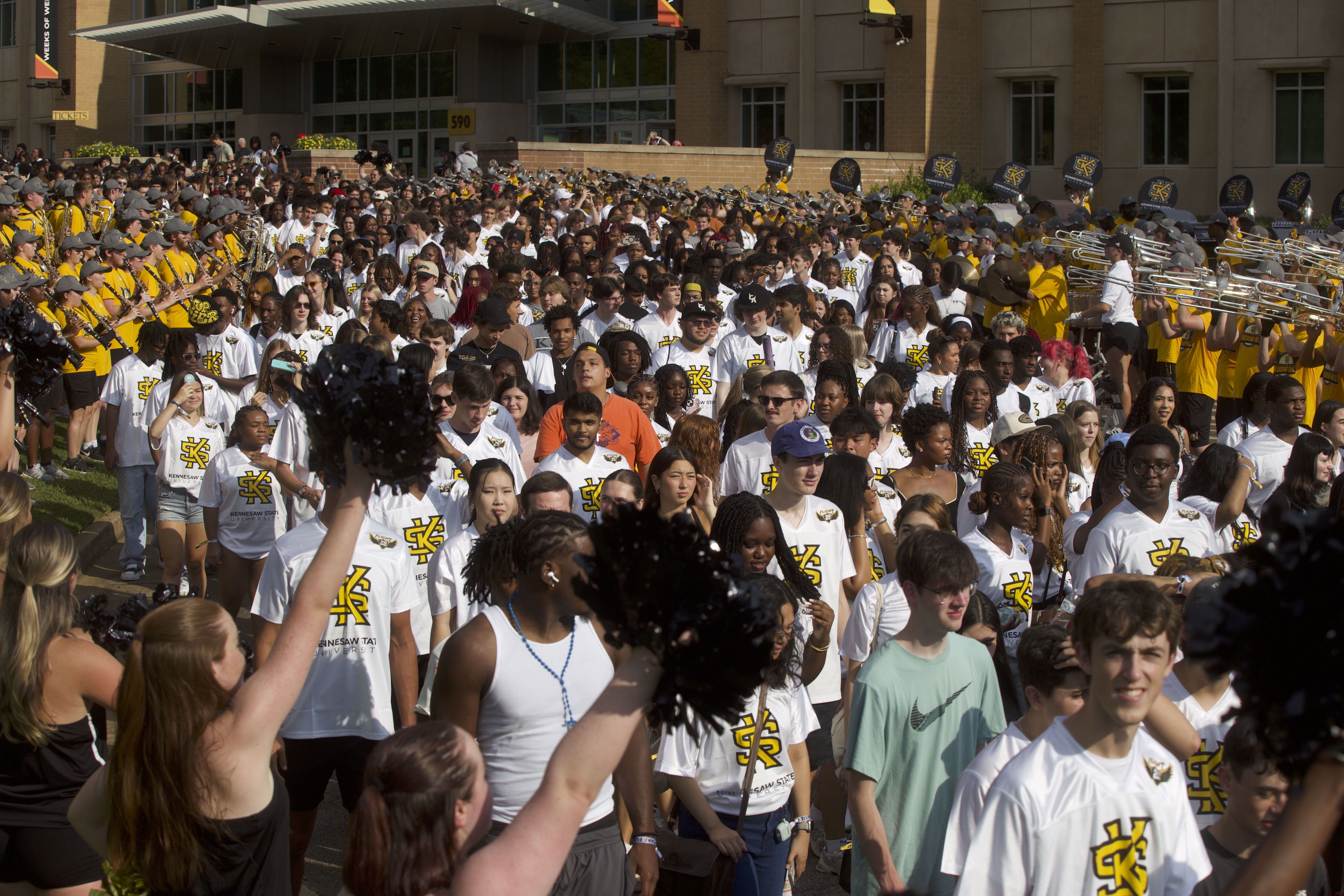
Kennesaw State Flight 29 students march outside Vystar Arena. August 17th, 2025. Photo Credit: Tye Brown/The Sentinel
Kennesaw State University (KSU) has grown rapidly from its beginnings as Kennesaw Junior College in 1963 to the third-largest university in Georgia.
For decades, KSU has built a reputation as an easily accessible and moderately selective public institution that provides solid academic programs while also investing heavily in expansion.
Its rise in national ranks during the 2000s and early 2010s reflected that trajectory, as enrollment growth matched the improvements in facilities, degree offerings and student outcomes.
A university’s credibility is shaped by several core factors: quality of instruction, admissions standards, campus resources, student success metrics and community reputation.
More specifically, an institution has been granted accreditation by an accrediting body that is recognized by the U.S Department of Education.
When all of these factors move in the same direction, its credibility strengths. However, when they drift apart, even a large institution such as KSU can lose public confidence.
Moreso, KSU’s current credibility problem centers on that disconnect.
The 2025 incoming class was the largest in the university’s history, which continued a pattern of aggressive over-admitting.
Enrollment growth alone is not a negative; however, credibility suffers when growth outpaces the infrastructure required to support it.
Students repeatedly highlight the same issues: overcrowded classes, insufficient parking, strained advising availability, long wait times for student services and a shortage of on-campus housing.
In all, KSU appears to believe in quantity over quality.
This perception is compounded by the belief that the university “lets anyone in.” KSU’s admission standards have remained relatively broad even as enrollment has continued to grow.
While accessible education is important, credibility depends on consistency and clarity. When admissions policies expand faster than academic resources, students interpret it as a lowering of standards rather than an intentional commitment to opportunity.
Public posts on platforms such as reddit and local forums reflect this concern. Students describe the institution as “overcrowded”, “unorganized” and “operating beyond capacity.”
These reputational hits accumulate quickly on social media.
KSU has all the means to regain credibility, but it will require intentional course correction.
First, the university should adjust admission that targets actual resource capacity. A temporary reduction or stabilization in enrollment would allow KSU to catch up on infrastructure, improve parking availability and increase staffing across advising, counseling and academic support offices.
Second, the university should revisit its admissions criteria and consider modest increases in GPA expectations and program-specific requirements. Raising standards would signal renewed commitment to academic strength.
In addition, KSU needs to be more transparent with students about resource allocation and long-term plans.
When universities acknowledge issues openly, articulate solutions and follow through, their credibility improves. Students are more willing to accept the growing pains when leadership communicates clearly and consistently.
Despite these challenges, KSU still offers meaningful strengths.
The university maintains strong business, nursing and engineering programs. It continues to invest in research capacity and benefits from the proximity to the Atlanta metropolitan area.
Many students value the affordability, campus life and opportunities for internships and employment. These advantages are real and worth preserving.
KSU’s credibility has not disappeared, but it has been strained. The core issue is not the growth itself; it is the growth without balance.
By aligning admissions decisions with campus capacity and reaffirming academic standards, KSU can rebuild trust and position itself as a stronger institution for the next generation of students.