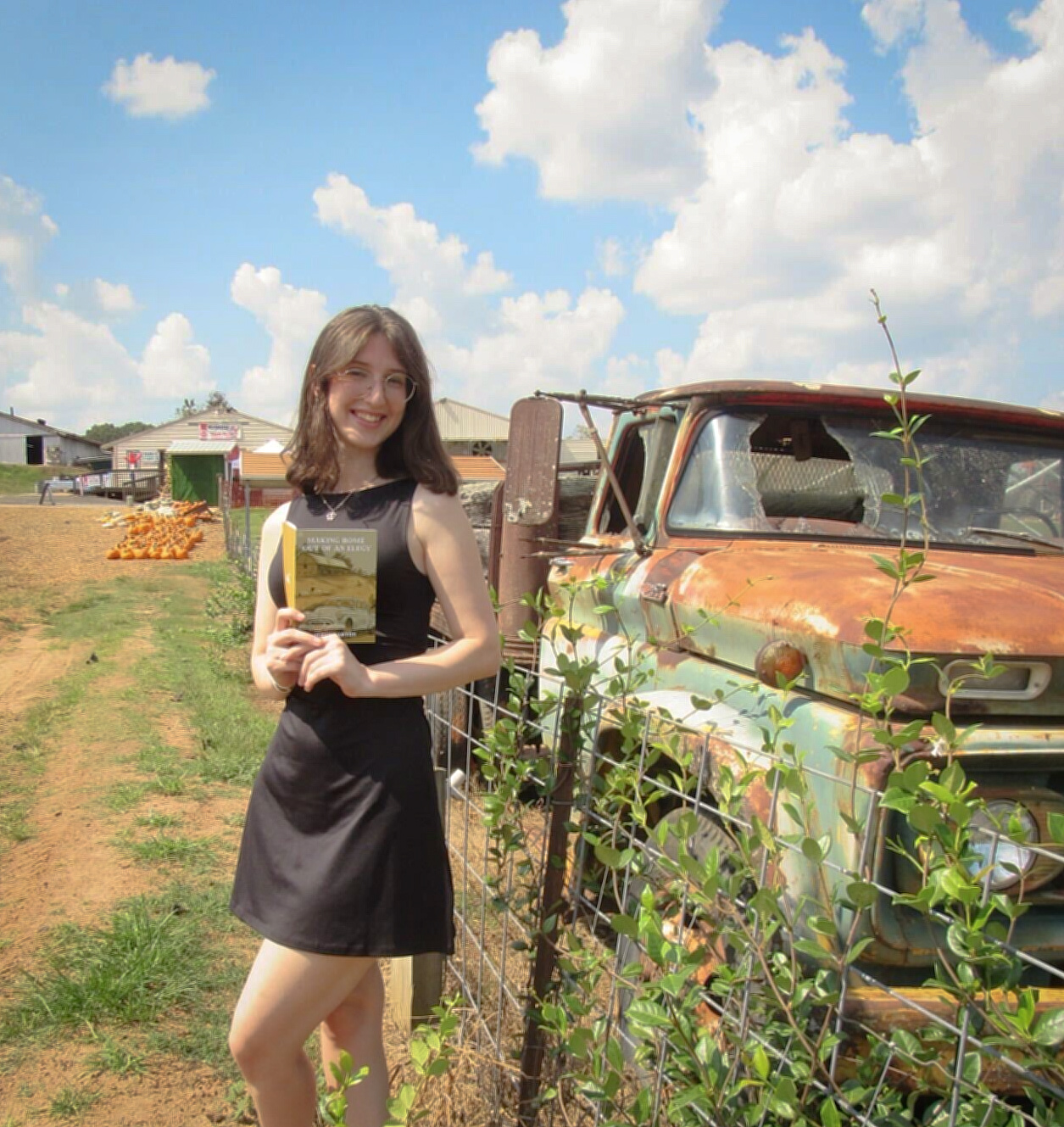
The Sentinel’s Alexis Barton poses with her new book. Photo Credit: Alexis Barton/The Sentinel
Kennesaw State University student, author and Opinion Editor of The Sentinel, Alexis Barton, tackles grief and perseverance through her poetry collection: “Making Home Out of an Elegy.”
The brief collection of raw, sentimental and meticulous poems touch upon her own experiences with loss and the deeply personal struggle to not lose yourself within the grieving process.
Written in the wake of her childhood cat’s passing, this collection of 11 poems is much more than a tribute to a beloved pet. It is also a brief window into Barton’s mind as we follow the ripple effect of grief through retellings of fresh losses, older traumas and future anxieties.
“I think of poetry as something that helped me think through who I was after losing something,” Barton told The Sentinel. “That’s the story, how there’s something after this [grief], or beyond it…”
The poems, Barton explains, were not originally written with a collection in mind. Barton shared that the pieces came together over the course of only a couple of months, from around mid-October to early December, 2024.
“[I] Honestly never thought these poems would see the light of day,” Barton said.
When asked about what poetry means to her and any intentions she may have had behind her writing, Barton replied, “I don’t know, honestly. [Poetry] lets me walk myself through the emotions I’m feeling. I think it is just like another form of expression for myself.”
While the creation for this collection arose from a personal loss, it ultimately led to a deeper period of reflection that expanded into much broader thoughts regarding loss, impermanence and identity.
Barton utilized poetry in this collection as a medium for both catharsis and introspection, especially during moments in which one might find themselves feeling entirely consumed by or lost within their own grieving process.
Her poetic voice shines through this collection with her particular use of the freeform poetry style, known mainly for its lack of adherence to the structures of rhythm or meter traditionally found in poetry. Barton’s utilization of this style mimics the way in which the grieving process naturally resists any kind of structure or predictability.
A strong example of this can be found in the poem “Papa,” a piece that reads like a letter directly addressing Barton’s late grandfather. She uses the freeform style to unfold the poem in a loose, almost conversational pattern that allows the emotions to guide its sense of rhythm.
These intimate memories are underlined by a recollection of wistful and tender images that evoke a sense of childhood innocence and adult heartache.
This stylistic freedom is consistent throughout the entire collection. Barton allows each poem to take the shape of the emotions they hold, layering the freeform structure with vivid visual imagery and allegorical language, rich in emotional honesty that makes each idea whole.
Themes of home, identity and persistence echo subtly but persistently throughout the entirety of this collection. The poems ask the reader: How do we carry on living in areas affected by loss, be it a physical home or ones’ own personal psyche? What parts of ourselves are lost, or possibly even discovered, while in mourning?
In turning her grief into poetry, Barton does not try to resolve these questions, but instead chooses to let them linger. She invites the reader to sit with the discomfort, the memory and the resilience that follows.
“Making Home Out of an Elegy” is a deeply personal and quietly ambitious meditation on how we take on the loss of a loved one, or even prepare for the inevitability of one.
Through honest, freeform verse, Barton allows us to walk beside her as she attempts to navigate through the somber and often disorienting terrain of bereavement. Her work offers a moment to witness how memory and vulnerability can lead to a place of quiet, yet grand self-reflection to those in the throes of grief.
Barton’s work shows that grief does not always need to be solved—sometimes it just needs space to be held and, in time, be made into a home.