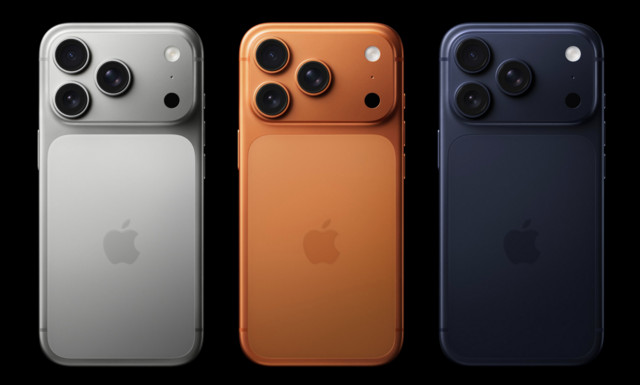
Apple’s iPhone 17 showcasing 3 new colors. Photo Credit: Apple
The tech giant’s new smartphone went on sale alongside new models for its most popular devices.
Along with the iPhones 17 Pro, Pro Max and iPhone Air, the device was launched with Apple’s nineteenth generation of iPhones.
Apple has also released new Apple Watch models, and the AirPods Pro3. With the addition of the operating system iOS 26, and improved, Apple Intelligence AI, the corporation has marketed this new wave of products as a milestone in tech.
According to Apple Newsroom, the new iPhones are distinguished by innovations in their designs, camera systems, and battery life.
Each model contains ceramic shield coating that enhances durability and scratch resistance. Their surfaces also have an anti-reflective design to reduce glare, and the Pro devices possess improved thermal systems to cool key components. These advancements complement interfaces with upgraded display features.
The new iPhones also contain rear 48-megapixel Dual Fusion camera lenses, with the iPhone 17 having one, along with a 12-megapixel telephoto lens, and its Pro variants three. Each of these provides enhanced optical quality, sharpness and detail.
Frontal cameras contain Center Stage lenses which allow for high-resolution photos and videos in any direction, as well as a dual-capture video feature enabling users to record with both front and rear cameras simultaneously.
The new camera features have become popular among potential consumers, including Jared Aifah, a civil engineering major at KSU who spoke with the Sentinel.
“The camera features stand out the most,” he said, “They all seem pretty cool, and have better quality than previous those of phones.”
All four models are sold with at least 256GB of storage, surpassing the 128GB of previous generations, and the Pro devices support a new 1TB configuration.
The expanded storage coincides with increased battery life, with Apple reporting that each iPhone now sustains all-day battery with faster charging and extended video playback.
“This also seemed interesting,” Aifa added on this development. “We’ll see how the battery life works out. It doesn’t look too bad and will probably make [the iPhones] easier for people to use.”
These innovations are supported by key hardware changes across the iPhone lineup, including the introduction of the A19 chip generation, Apple’s most advanced.
“When comparing [Apple’s former] chip with the A19 chip,” remarked Dr. Bobin Deng, an assistant professor of Computer Science at KSU, on the chip’s power, “one of the key upgrades is that the A19 hardware integrates a neural accelerator for every GPU core specifically designed to handle AI computations efficiently.”
This allows the devices to support advanced Apple Intelligence software, as well as other features like ProMotion display, increased RAM, and 24-hour battery.
They are accompanied by N1 networking chips, which support Wi-Fi 7, the Threads protocol, and Bluetooth 6, while also improving AirDrop and Personal Hotspot performance.
Furthermore, the iPhone Air is unique as, at 0.22 inches thin and 0.36 pounds, it is Apple’s thinnest smartphone. Despite this, the titanium device shares many key features with the iPhone 17s, while lacking the dual and triple-lens camera systems of its counterparts.
In addition to its new iPhones, Apple’s newest generations of Apple Watches and AirPods have also seen significant development.
All three Apple Watch models, the Series 11, Ultra 3, and SE 3contain novel health features. The Series 11 can uniquely detect signs of chronic high blood pressure, and hypertension, while all three models offer features like sleep score tracking, heart rate notifications, and detections for falls and crashes. They also offer 5G connectivity, improved battery life, and more power-efficient hardware.
The Ultra 3 also provides connectivity to space satellites to enable users to contact emergency services and share their locations while off the grid, though such features are only free temporarily.
The final product Apple has released, the new AirPods Pro 3, also has various advancements, including enhanced noise cancellation, spatial audio, and water resistance. They also provide an innovative Apple Intelligence-powered live translation feature that allows users to listen to translated audio while speaking to someone in a foreign language in real time.
This feature has impressed numerous experts, including Dr. Deng, who specializes in AI research. “The live translation feature of the AirPods Pro 3 stands out to me the most,” he claimed. “It enables us to communicate effortlessly with people who speak different languages, even while keeping our hands free.”
Nonetheless, he did recognize its limitations, including that its current version only supports five languages, something he commented “seems insufficient and should be expanded further.”
“However,” Dr. Deng said, “whether the current translation AI model can handle additional languages remains unclear. If a more powerful AI model is required in the future, balancing power consumption with AI capability may be a critical challenge.”
Live translation runs through Apple Intelligence on the new iPhones, which Dr. Deng explains allows the AirPods to collaborate with the iPhones to translate “without requiring a Wi-Fi or cellular network connection.”
The Air Pods Pro 3 can also track a user’s heart rate and possesses a more ergonomic design to increase comfort and utility.
Much of the extensive software innovation is the product of Apple’s new operating system, iOS26. It has introduced dynamic improvements in user interfaces, battery power, security, and app performance across all devices. The operating system has also been instrumental in the efficiency of the new Apple Intelligence features.
Additionally, Apple has released various accessories, including new iPhone cases, and Apple Watch bands. These, however, are sold separately from the devices themselves, whose prices remain consistent with previous levels, apart from the iPhone 17 Pro, which has seen a $100 hike.
As Apple’s newest generation of products continues to hit the market, its full impact on the future of tech innovation has yet to be seen. While the company has promoted it as groundbreaking, many have taken a more circumspect view, but it is nevertheless bound to be impactful.
“[The devices] may not seem that groundbreaking or revolutionary,” reflected Aifah, “but it doesn’t mean they’re bad. Their features seem helpful overall, so they might be an interesting buy.”