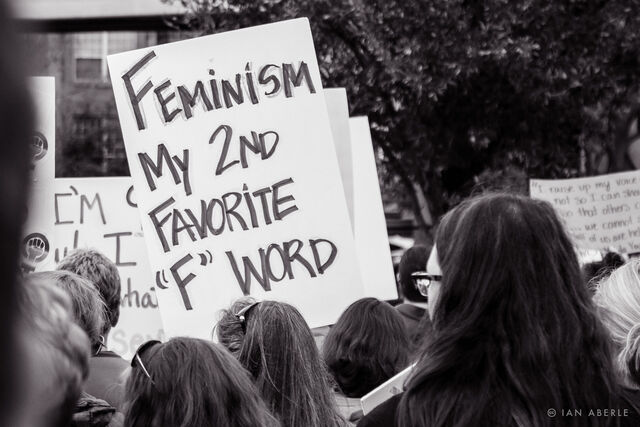
Protester with sign that reads “Feminism my 2nd favorite F word”. January 20th, 2018. Photo Credit: Ian Aberle
Can every choice be considered feminism?
Choice feminism—an ideology that asserts any choice a woman makes is inherently feminist, so long as it is a choice made of her own agency— has recently remerged in the popular imagination.
It follows on the increasingly popular heel of the tradwife influencer, a type of female influencer whose household follows the more traditional mold of the husband working to provide and the wife staying home to tend to her household and children.
When faced with criticism—accusations that “tradwifery” sets women back and these women are choosing a dangerous path primed for failure—the tradwives shoot back.
They insist that the feminists who criticized them only do so because they made a choice that the feminists did not like, which goes against the right to choose that feminism is supposed to fight for.
It’s easy to understand why this line of thought is appealing. Historically, and even today, women are barred from making decisions about their future.
But that’s all choice feminism concerns itself with: the surface.
Most feminists—from liberal to radical—agree that they live under a patriarchal structure. They agree that it must be challenged, from insisting that change could happen inside the system, to demanding a total collapse of patriarchy itself.
However, one can only work within a system so much before their actions begin to mirror the system itself.
This is the peril of choice feminism: in its desperate attempts to empower women without rocking the boat, it normalizes the patriarchal structure it claims to fight by asserting that every choice, even ones that uphold patriarchy, are empowering.
Everyone is deserving of self-determination. However, when we hyper-focus on empowering only our individual choices using feminism as a defense, we miss the goal of feminism itself: liberation for all women.
One cannot support choices that harm women and call themselves feminist because these choices have consequences.
Across the political spectrum, women, especially those in power, can make choices that harm other women. They can make choices that harm themselves.
Choice feminism ignores this by pointing out that because a woman made those choices, the choice should be celebrated.
These high positioned women end up on posters, giving speeches on television and cheering for each other at political rallies as they speak about empowering women, all the while standing on the backs of the women harmed with their choice.
The same goes for the tradwife: on the surface, she’s merely an influencer posting herself baking and working on her farm, and she has the right to do so. But when scrolling further, posts surface about 100% submission to her husband, shortening maternal leave or even repealing the 19th amendment.
It would be one thing if these women were discussing it to like-minded friends on a private page, but that’s not the case.
These women are garnering platforms with hundreds of thousands of followers, being invited to talk shows and having political figures leap to their defense, who then attempt to pass laws aligned with these values.
Choice feminists actively talk about having a right to choose while at the same time condemning the alternate choices of women outside of their ideological sphere. If we continue to accept that anything can be labeled as feminist, how long before the word loses its meaning? If that happens, is the fight even worth it?