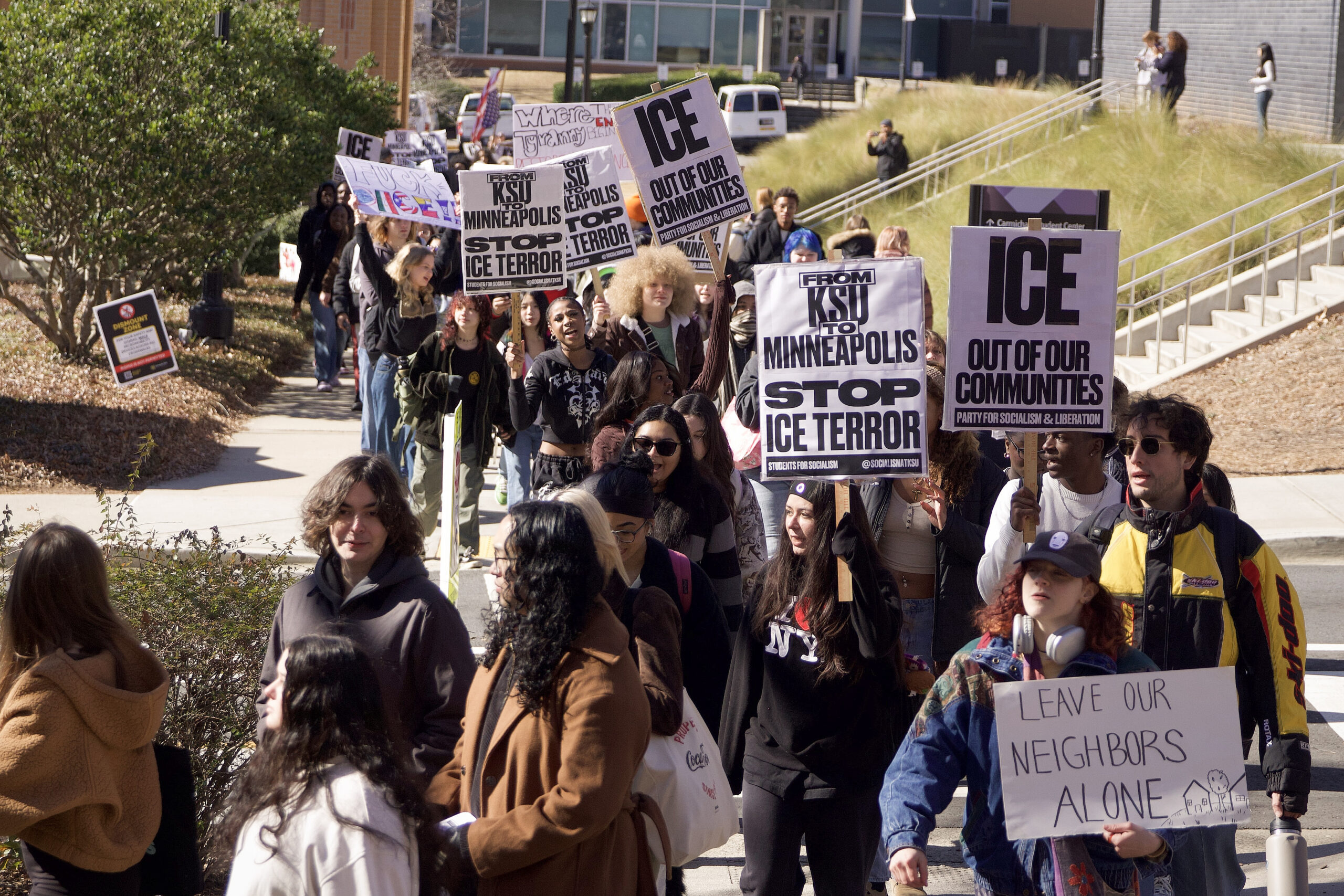
Kennesaw State students march in Anti-Ice protest. January 20st, 2026. Photo Credit: Tye Brown/The Sentinel
As ICE protests grow louder on and off campus, students are left wondering if their voices can spark real change.
Last December, the Trump administration deployed over 2,500 Immigration and Customs Enforcement (ICE) to Minnesota as a part of “Operation Metro Surge”. Since then, tensions have been high all over the country with protesters flooding the streets of large cities urging the administration to remove ICE from their communities.
Kennesaw State held its very own protest in light of the death of Minnesota resident, Renee Good, who lost her life on Jan. 7, 2026. Good was shot by an ICE officer in her car, while attempting to warn her neighbors about ICE’s presence.
Many feel that these agents are not using proper protocol when they detain individuals, with many of those who have been detained being citizens, or legal residents.
While these protests have yielded significant turnout, many are left to wonder what they will actually accomplish.
Throughout history protests have been a very popular way of raising attention for certain causes. Campaigns like the Civil rights movement, Black Lives Matter and MeToo are famous for the impact and media coverage that they garnered.
The Civil Rights movement led to the passage of the Civil Rights Act of 1964, which prohibits the discrimination of individuals on the basis of race, color, religion, nation of origin. The #Metoo movement led to the passing of many bills, including The Ending Forced Arbitration of Sexual Assault and Sexual Harassment Act of 2021.
In the past, protesting seemed to have an impact, whether it lead to the passing of laws or bringing global attention to an issue.
Kennesaw State Political Science Professor Ramzan Kilin cendorsed the idea that these kinds of protests can bring real change.
“Political science research shows that protests can indeed raise public awareness and shift the national conversation. While not all protests immediately produce policy change, they often influence political agendas, mobilize public opinion, and signal to policymakers that certain issues carry significant public concern,” Kilinc said.
While stating that protests may not have instant results and policy shifts, Professor Kilinc emphasized their role in having a long-term impact on the public and elected officials.
“Protests can generate pressure that encourages elected officials to reconsider or clarify policies,” Kilinc said.
“Even when policy changes are not immediate, protests can strengthen civic engagement, shape future electoral choices, and build long-term social movements that eventually lead to reform.”
Kennesaw State University wasn’t alone in holding ICE protests. College students all across the state participated in walk-outs. These schools included University of Georgia, Georgia State University, Emory University, Georgia Tech and Georgia Southern University.
Former Kennesaw State University student Sanaai Drayton felt that these protests can garner the attention of local officials, possibly leading to change.
“I think students should expect at the very least their local officials to notice them, and how important this issue is,” Drayton said. “I think our state congress members should view the ICE protests spread across schools in Georgia as a signal that they need to speak up.”
While protests may not instantly result in policy change, they continue to serve as a powerful tool for amplifying public concern and pressuring leaders to respond.
For many students and activists, the ICE protest are less about instant reform, and more about ensuring that their voices are heard, seen and remembered.