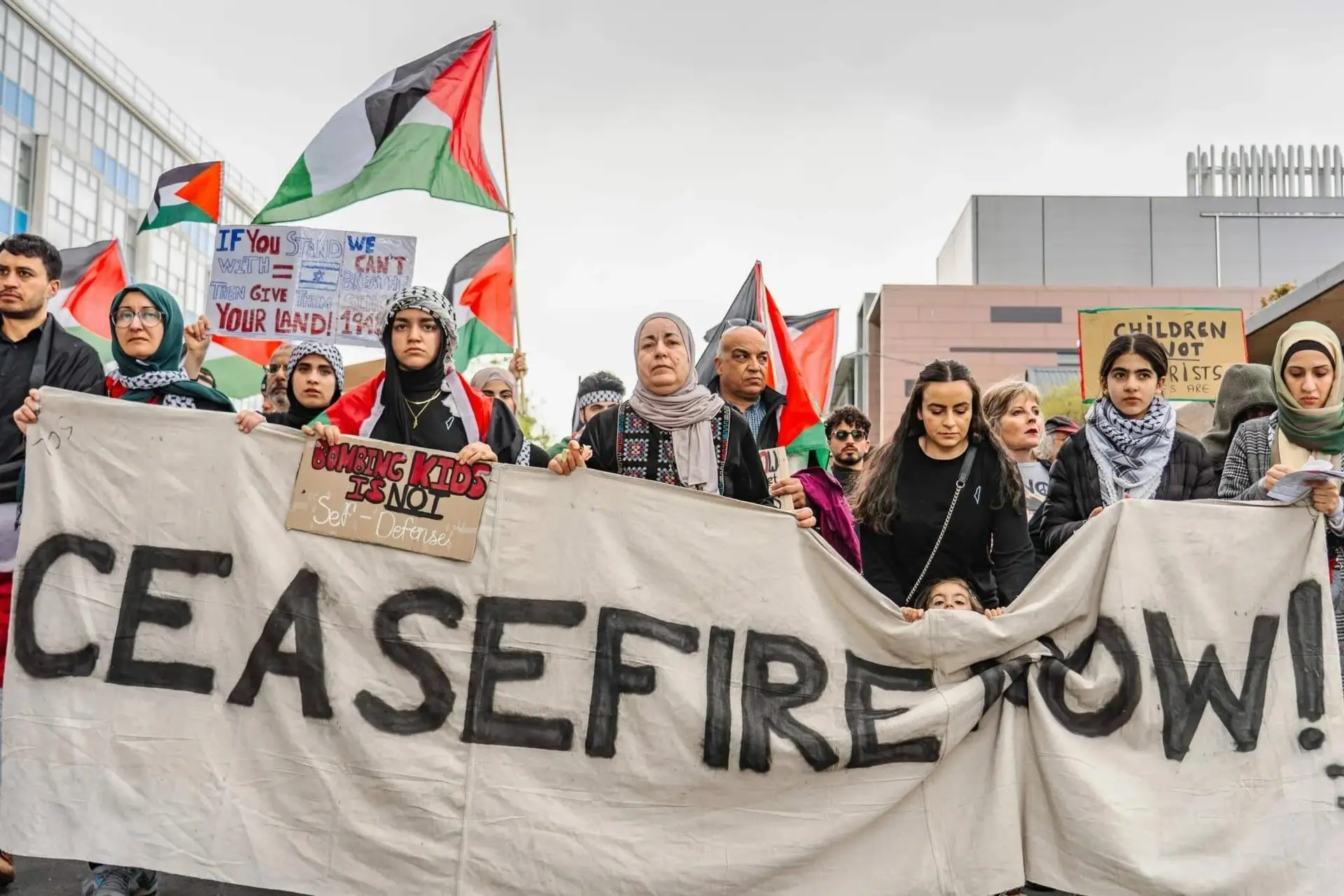
Protesters protesting the war on Gaza. November 3rd, 2025. Photo Credit: Magali Osowski
On Oct. 10, Israel and Hamas entered into a ceasefire deal mediated by the governments of the United States, Egypt, Turkey and Qatar as part of a larger plan to end the Israel-Hamas war that began in October 2023.
On Oct. 28, less than three weeks later, Israel launched a series of what Israeli Prime Minister Benjamin Netanyahu referred to as “powerful strikes” across Gaza, killing 104 people. The attacks were in retaliation for the killing of an Israeli soldier, which Israel blamed on Hamas.
Hamas rejected the accusation and said it was committed to upholding the terms of the ceasefire. After the attacks, Israel also said that the ceasefire was back on. Both sides, however, blame each other for violating the ceasefire in the first place.
This incident was not the first violation of the Oct. 10 ceasefire, and it will not be the last, but it does raise an important question: do ceasefires actually work?
The answer is no.
At best, ceasefires only temporarily pause hostilities rather than promoting long-lasting peace and ending conflicts. Historically, most ceasefires end with one or both sides breaking the truce and attacking the other. Ceasefires can last years, but they are never permanent.
The best examples of this come from the broader Israeli-Palestinian conflict, which began in the late 19th century with the first arrivals of Zionist settlers in Ottoman Palestine.
After the Ottoman Empire’s defeat in World War I, the League of Nations, the ill-fated predecessor to the United Nations, granted Britain a mandate to rule Palestine in 1922. Britain had previously voiced its support for the Zionist cause in the 1917 Balfour Declaration, which caused an explosion of Jewish immigration in Mandatory Palestine, leading to increased tensions between Jews and Arabs in the territory.
With tensions on the rise, the newly created United Nations proposed a partition plan in 1947 that would end the British mandate and create an Arab state and a Jewish state in Palestine, as well as a “Special International Regime” in Jerusalem that neither state could control due to the site’s shared importance in Judaism and Islam.
Under the partition, the Jewish state would receive about 56% of the territory in Mandatory Palestine, while the Arab state would receive about 43%.
The Zionists supported this plan, but the Arabs did not, leading to a civil war that transformed into a larger regional war and ended in 1948 with a Jewish victory, the establishment of the State of Israel and the displacement of over 750,000 Palestinians in what is known as the Nakba.
The 1948 Palestine war was the first war in the complex history of the Israeli-Palestinian conflict, and in a way it never ended. In reality, the conflict is one long war occasionally punctuated by failed truces, armistices and ceasefires.
Since Hamas gained control of Gaza in 2007, there have been several ceasefires between Israel and Hamas, including ones in 2008, 2012, 2014, 2019, 2021, 2023 and January 2025.
Each one of these ceasefires ended due to a failure to negotiate the terms of the agreement or because of violations committed by one or both parties.
In his 2014 address to the United Nations, Jewish-American political theorist Noam Chomsky said of the ceasefires: “A ceasefire is reached; Israel disregards it and continues its steady assault on Gaza, including continued siege, intermittent acts of violence, more settlement and development projects, often violence in the West Bank.”
He continued, “Hamas observes the ceasefire, as Israel officially recognizes, until some Israeli escalation elicits a Hamas response, which leads to another exercise of ‘mowing the lawn,’ in Israeli parlance, each episode more fierce and destructive than the last.”
Chomsky gave this address two months after the ceasefire agreement of 2014 had been reached. Since then, at least 4 more ceasefires have been broken in Gaza, and the recently negotiated Oct.10 ceasefire seems to be becoming more fragile with each passing day.
The question remains: what can be done about this?
The truth is, without significant reforms to the United Nations, not much progress can be made in fostering peace in Gaza.
The United Nations Security Council (UNSC) consists of 15 members: 10 non-permanent members who are elected by the General Assembly and serve two-year terms and 5 permanent members that have veto power, which are the United States, the United Kingdom, China, Russia and France.
This veto power stops the adoption of a proposal if even one member decides to exercise it.
The United States exercised its veto power in January 1976 to block a resolution calling for a two-state solution to the issue along the territory’s borders drawn in 1967.
The U.S. also used this power as recently as 2024 to veto Palestine’s request for full UN membership, denying its right to self-determination. As long as one veto ends these discussions, it’s unlikely that there will ever be peace.
With the future of Gaza looking uncertain, one can only hope that this latest ceasefire will be the first one to work.