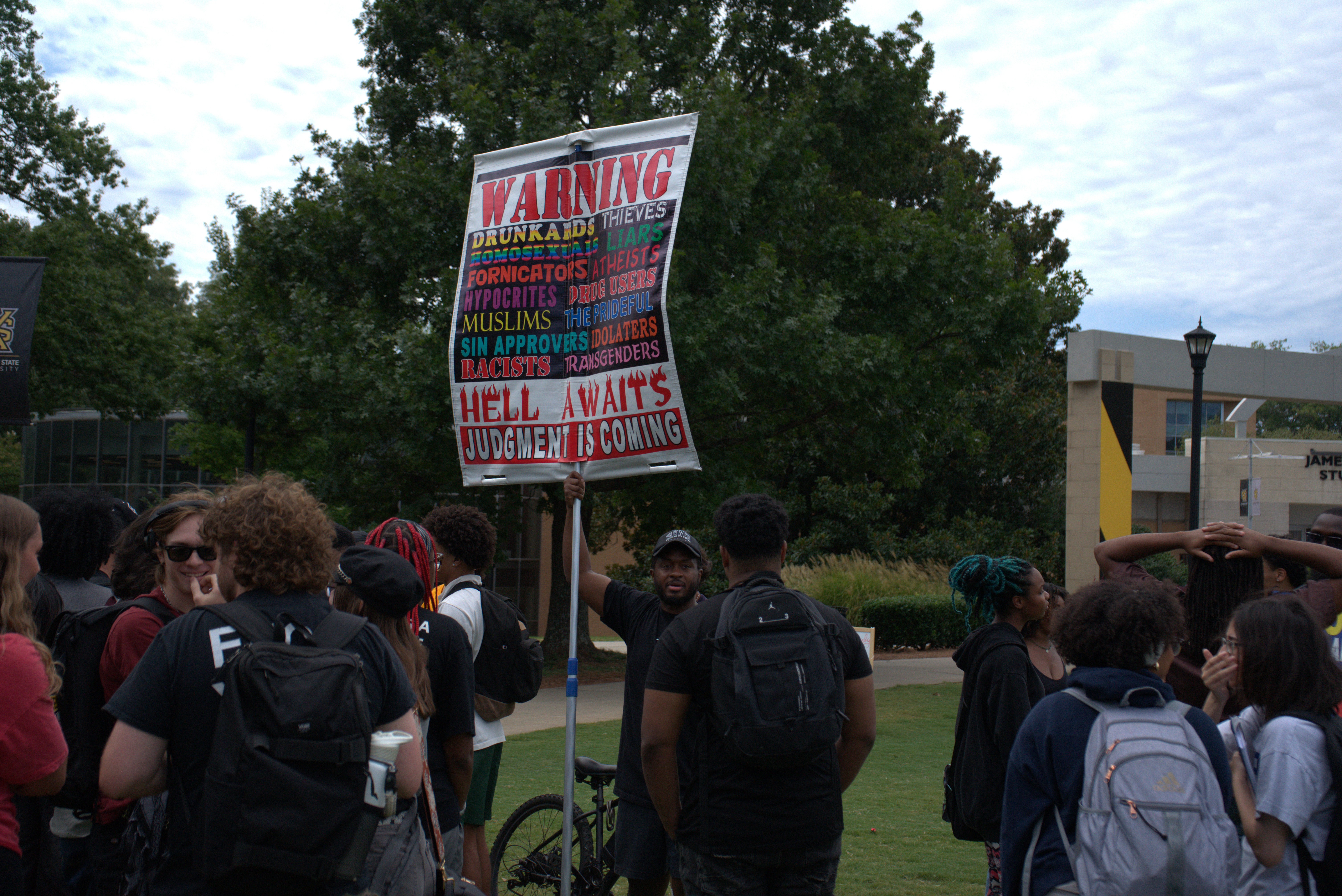
Religious protesters expressing their beliefs on KSU’s Campus Green. August 26th, 2025. Photo Credit: Tye Brown/The Sentinel
The First Amendment of the United States Constitution guarantees the fundamental right of free speech, press, assembly and petition.
On college campuses, this principle of free speech holds special weight: institutions of higher learning must serve as forums for students of diverse backgrounds, viewpoints and beliefs to come together and exchange ideas respectfully.
Yet, it cannot be ignored that freedom of speech is not limitless.
Expressions of violence, intimidation or even targeted hate speech to specific groups compromise peaceful discussion, which threatens the very purpose of universities being safe havens to think freely.
At KSU, the Campus Green and other “designated campus areas” are places where students can freely share their ideas.
According to KSU policy, “all unrestricted outdoor areas” are public forums for expressive activity, and the Green Zones (zones 1-7) are explicitly identified as such.
Registered student organizations and external groups may hold protests, displays, debates and religious observances provided that they follow guidelines and avoid disrupting campus functions.
Recently, a number of events on KSU’s campus have illustrated the freedom of speech expression and some of the tensions that follow.
Following proposed cuts to diversity and equity inclusion (DEI) resource centers in May, students rallied on the Campus Green to express their opinions on the matter.
Anti-abortion advocates also set up signs on the Green consistently, inviting students to have discussions with them about their beliefs regarding reproductive care. Religious events and evangelical outreach have also been regular fixtures on the Campus Green.
On a more recent occasion, conservative-leaning student groups hosted a memorial for conservative activist Charlie Kirk, which was disrupted by protesters and led to the arrest of a student for alleged battery and obstruction of law enforcement.
Despite the diversity of these expressions, the controversies underline one main issue: the line between legitimate protest and plain hateful behavior.
The Charlie Kirk vigil, in which speakers were jeered with racial slurs and physical altercations, suggests that this gathering devolved beyond peace.
Likewise, the anti-abortion display raised concerns among students who argued that graphic images crossed into harassment of vulnerable peers.
These events demonstrate that while freedom of expression is integral, the university also bears responsibility for preserving a campus climate that is all inclusive, civil and not hostile to participation.
College campuses should remain an environment where open discussion is encouraged and different beliefs are respected.
Every student, regardless of background or political stance, deserves the right to speak freely without fear of being silenced.
Supporting free speech does not mean agreeing with every single viewpoint. It means recognizing that most perspectives have a place in the public discourse, as long as they are expressed without harm.
Kennesaw State University, like many institutions, continues to navigate the balance between protecting expression and maintaining civility. True freedom of speech requires understanding and tolerance.
When discussions remain peaceful and grounded in respect and both sides are learning more about each other, students gain knowledge and learn how to listen and grow together.