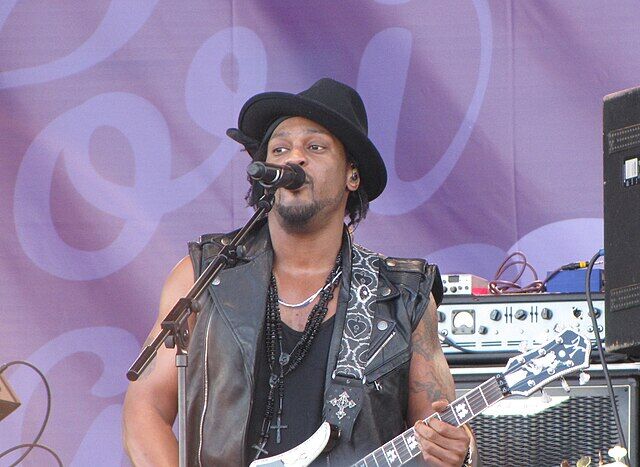
Artist D’Angelo performing at Pori Jazz festival in Pori, Finland. July 20, 2012. Photo Credit: Roquai
Beloved R&B figure D’Angelo died at the age of 51 on Oct. 14 after a long and private battle with pancreatic cancer.
Recovering from the tragedy of his loss, the singer’s family spoke to People.com to memorialize his legacy as an incredible artist and a cultural trailblazer.
“We are saddened that he can only leave dear memories with his family, but we are eternally grateful for the legacy of extraordinarily moving music he leaves behind,” the family said.
D’Angelo, or Michael Archer, was in the process of creating his fourth unnamed studio album with legendary R&B singer and songwriter Raphael Saadiq at the time of his death. The project’s future is still unknown and has yet to be commented on by those involved.
D’Angelo started as a melody-obsessed child in a family with great musical talent. Gradually, this obsession turned into iconic discography and landed the singer as the pioneer of the sub-genre dubbed “Neo-Soul.”
Even at an early age, it was clear that D’Angelo was born to create music.
After watching his brother play the piano for the first time, three-year-old D’Angelo had his heart set on crafting music filled with the same awe of this experience. Evangelical influences from his Pentecostal childhood home became evident in his music as he released material over the years.
He began his illustrious solo career with the release of his 1995 album, “Brown Sugar.” Combining the traditional instrumentation of contemporary hip-hop acts with the soulful vocal delivery of musical titans like Prince, D’Angelo quickly carved out his own niche within music circles.
The album’s lead single, also titled “Brown Sugar,” showcased a different style of smooth crooning that fans were not yet accustomed to. Marcus Moore, a contributor for Pitchfork, a popular music-based review and news publication, encapsulated the effect this project had on fans at the time of its release.
“His blend of 1970s R&B and hip-hop felt uniquely vintage and modern,” Moore said. “He appealed to wide swaths of listeners and helped usher in a new strain of black music.”
His soulful debut album set the innovative precedent that D’Angelo would follow for the rest of his multi-decade career.
D’Angelo quickly became a significant contributor to R&B’s new “Neo-Soul” movement, alongside artists such as Erykah Badu, Maxwell, Lauryn Hill and Jill Scott. He kickstarted a golden age for not only R&B, but the entire African-American sphere of music.
D’Angelo’s first album set the bar high for his musical talents. However, his second album release, “Voodoo,” blew these high expectations out of the water.
“Voodoo” is by far the singer’s most acclaimed record to date. The introduction of increasingly complex chord progressions and elegant dynamics made it one of the most beloved R&B albums ever released.
The album wears its hip-hop influences fashionably on its sleeve, featuring performances from Wu-Tang Clan rapper Method Man and rap legend Redman. The project’s playful nature made it an instant hit among mainstream listeners, landing it a two-week placement as The Billboard 200’s highest-charting album.
D’Angelo then pivoted his musical approach to display his biblical roots, creating gospel-inspired epics such as “Untitled (How Does It Feel)” and “Send It On.” “Untitled” won Grammy awards in the categories “Best R&B Album” and “Best Male R&B Vocal Performance” in 2001.
Coming off of what was perhaps the highest point of his career, the singer unexpectedly took a 14-year hiatus from music endeavors.
D’Angelo was reportedly at odds with his status as R&B’s male sex symbol. This, paired with a near-fatal vehicle accident in 2005 and an alcohol and drug addiction sidelined him for years.
Frustration from these struggles was eventually reflected in his 2014 album, “Black Messiah.” Its politically-charged lyrics and brain-altering production were the main attractions displayed throughout the album’s runtime. Opening with the anxiety-dissolving track “Ain’t That Easy” and closing with the heartbreaking “Another Life,” D’Angelo completed one of the greatest collections in the music industry.
Today, D’Angelo’s influence is still demonstrated in the music of modern contemporary sweethearts such as Frank Ocean and production savants like Tyler, the Creator. The singer’s impact on the modern music industry can be seen in anyone who opened their souls to his art.