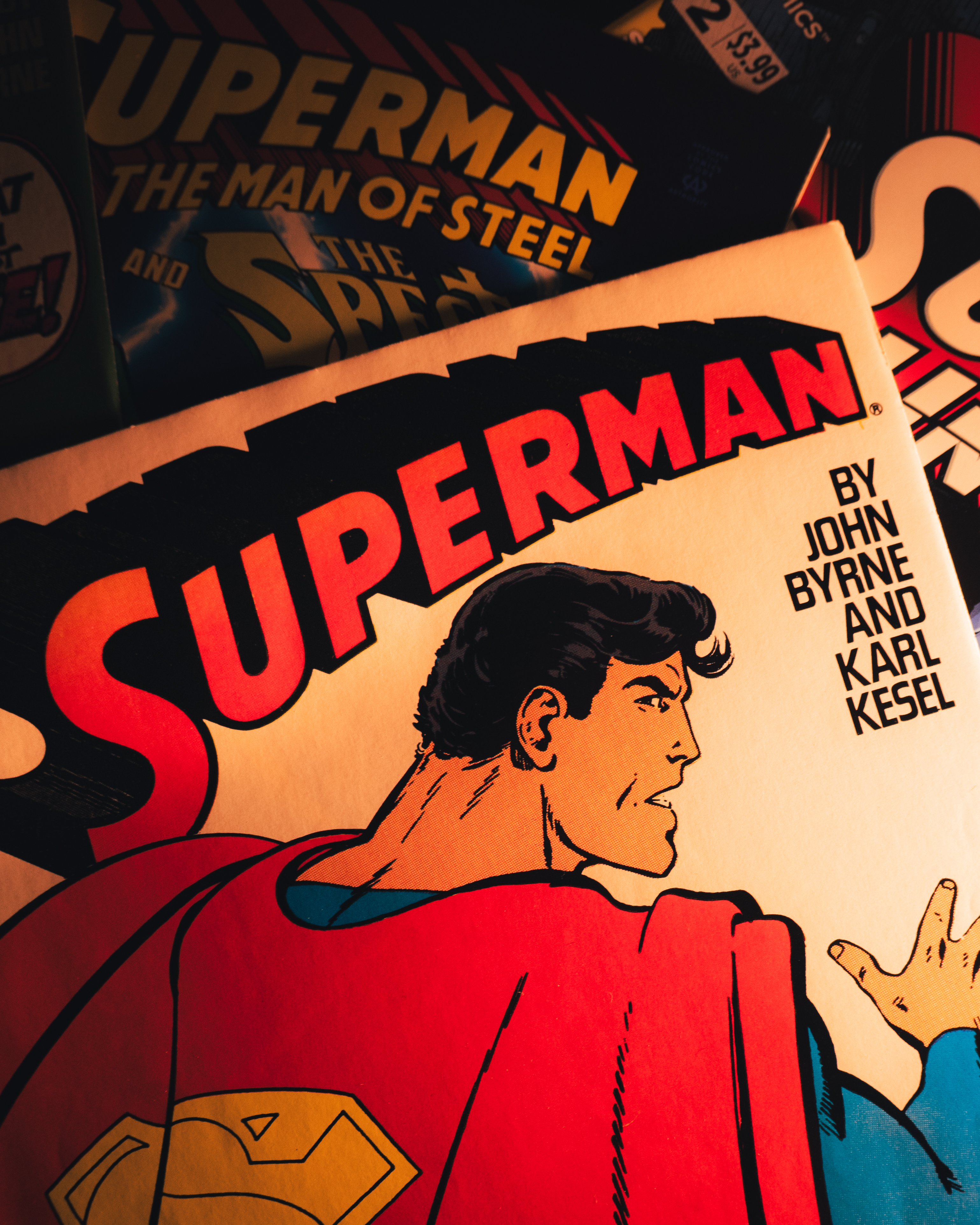
Collection of Superman comics. September 15th, 2025. Photo credit: Elikhai Ryan/The Sentinel
From the “Champion of the Oppressed” to American propaganda– Who is Superman?
James Gunn’s “Superman” arrived in theatres all across America on July 11, bringing a new version of the hero that might just answer the question: Who is the real Man of Steel?
Superman was created in 1938 during the Great Depression by two sons of Jewish immigrants, Jerry Siegel and Joe Shuster. The duo dubbed the character “champion of the oppressed” in Action Comics’ issue No. 1, and for the first few years, that was what the character stood for.
Early Superman comics showed hero fighting domestic abusers, corrupt businessmen and even destroying property to force the city to build better housing for low-income individuals.
However, this radical version of the character, which has even been called a “super-anarchist,” did not last long. In the 1940s, the United States entered WWII, and the government soon saw Superman as a valuable tool to build support for the war effort and sell war bonds. By the late 1940s, the character was no longer the same one that Siegel and Shuster had created.
In 1943, a radio serial coined the phrase, “truth, justice and the American way,” symbolizing how ingrained the character became with American culture around this time. In the 1950s, however, the character and the comic book industry saw another shift.
Dr. Fredric Wertham published his controversial book, “Seduction of the Innocent” in 1954. The book made a bold claim that comic books caused juvenile delinquency and that Superman was a fascist. This led to the creation of the Comics Code Authority, and Superman stopped fighting abusers and corrupt politicians.
The hero’s comics began to have more fantastical elements, while also reinforcing the political ideas of the time relating to gender norms and American globalization.
In 1970s, the comic book industry began to struggle, and DC Comics attempted to make serialized stories. This change led to stories with a focus on Superman’s human side and more mature stories, which culminated in 1992 with The Death of Superman.
In 2021, DC Comics officially changed Superman’s motto to “truth, justice and a better tomorrow” in an attempt to bring the character back to what Siegel and Shuster originally envisioned. The goal was to make Superman not only an American hero, but a global one.
Gunn’s “Superman” reflects many eras of the character. He is more human, like the version from the 70s-90s, but he is not focused only on promoting American ideals like earlier 2020s version.
However, at his core, this Superman is the hero of the oppressed and the working class that Siegel and Shuster created more than 80 years ago. For this new generation of fans, Superman will be a hero who believes that compassion for others should surpass any political affiliation or monetary gain.
Superman has been a radical anarchist, a piece of American propaganda, a kid-friendly tale, a human and a god-like figure. So, who is Superman?
There is only one answer: Superman is whatever we need him to be- he is a reflection of the culture of the time.